
What Are APQP and PPAP? Advanced Product Quality Planning and Part Approval
What are APQP and PPAP and what phases do they involve? Advanced product quality planning, PPAP elements, AS9145, and control plan-FMEA management with ERP.
What Are APQP and PPAP? Advanced Product Quality Planning and Part Approval
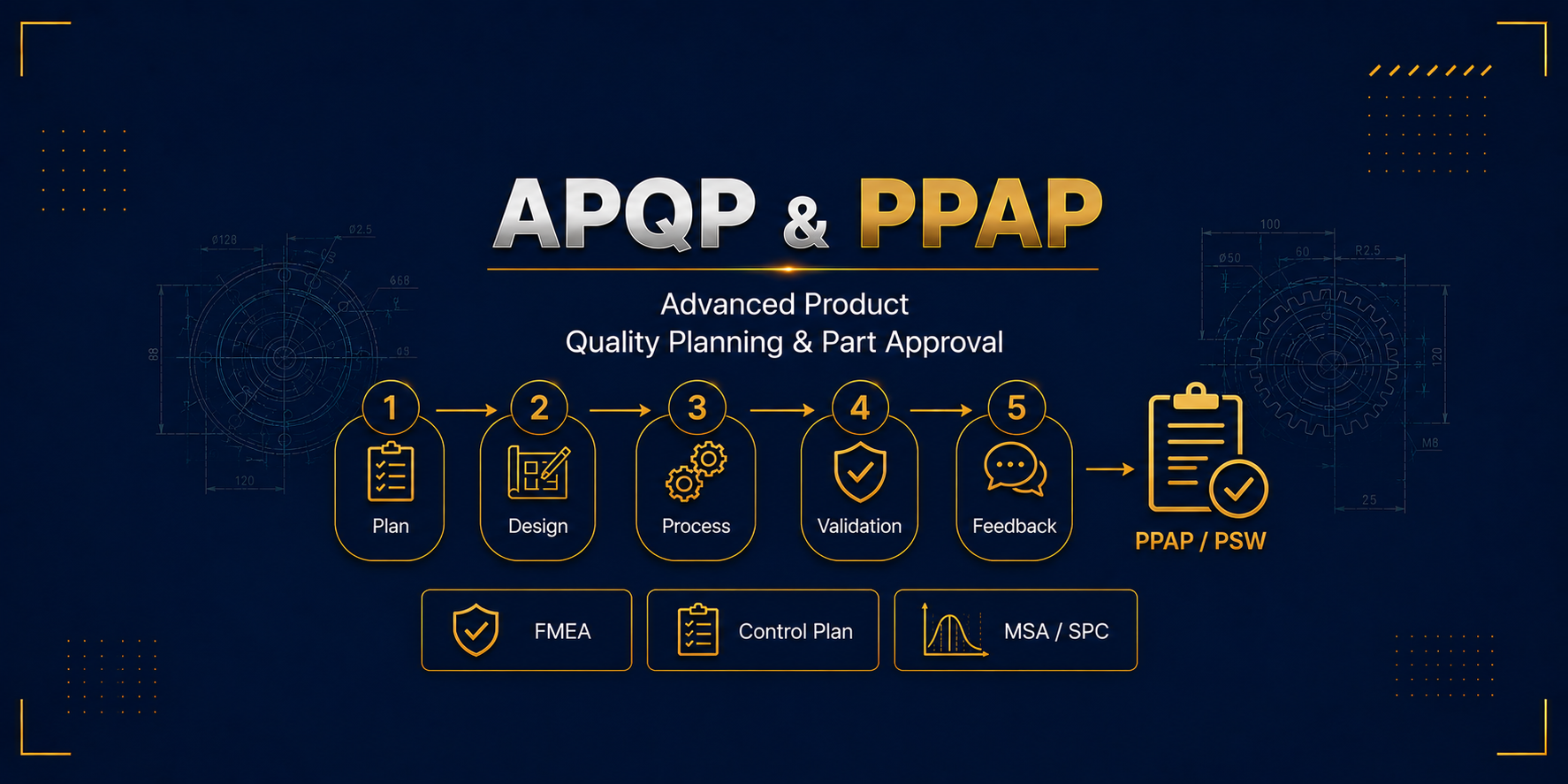
Short answer: APQP (Advanced Product Quality Planning) is a structured method that develops a product from design to serial production in five phases, planning quality from the very start. PPAP (Production Part Approval Process) is its output: the document package that proves the production process consistently produces conforming parts. In short, APQP answers “how do we plan,” and PPAP answers “how do we prove it.” In aerospace and defense, the two are applied together under the AS9145 standard.
Moving into serial production “by trial” is an unacceptable risk in aerospace and defense. APQP and PPAP prevent exactly that: they plan the product at the design stage, manage risks up front, and prove the process makes the right part before serial production begins. This guide covers APQP’s five phases, PPAP’s elements, its counterpart in an AS9100 environment, and how an ERP simplifies the process.
What Is APQP?
APQP (Advanced Product Quality Planning) is a framework that plans design, process and validation activities up front to ensure a product meets customer expectations. Its origin is the automotive sector (AIAG); its goal is to prevent defects at the planning stage rather than in production. APQP makes quality a designed-in output, not an after-the-fact inspection.
What Are the 5 Phases of APQP?
| Phase | Name | Focus |
|---|---|---|
| 1 | Plan and define | Customer expectations, goals, preliminary product/process plan |
| 2 | Product design and development | Design, DFMEA, design verification |
| 3 | Process design and development | Flow, PFMEA, control plan, work instructions |
| 4 | Product and process validation | Trial production, first article inspection, PPAP |
| 5 | Feedback and corrective action | Performance monitoring, CAPA, continual improvement |
What Is PPAP?
PPAP (Production Part Approval Process) is the standard document package with which a supplier proves that its production process can produce parts meeting customer requirements. PPAP grants “approval” for serial production and typically consists of 18 elements.
What Are the PPAP Elements and Submission Levels?
The main elements of the PPAP package are:
- Design records and engineering change documents (configuration)
- DFMEA and PFMEA
- Control plan
- Measurement Systems Analysis (MSA) and calibration records
- Dimensional results and material/performance test reports
- Initial process capability studies (SPC / Cpk-Ppk)
- Sample parts and a master reference sample
- Part Submission Warrant (PSW) — the signed document that summarizes the package
PPAP has 5 submission levels (Level 1 submits only the PSW, while Level 3 is the most common and covers all elements).
What Is the Relationship Between APQP and PPAP?
APQP is a planning process, while PPAP is its output. Phase 4 of APQP (product and process validation) produces the PPAP package. In other words, PPAP is the organized presentation to the customer of all the evidence (FMEA, control plan, MSA, dimensional results) generated throughout APQP.
How Are APQP/PPAP Applied in Aerospace-Defense? (AS9145 and FAI)
The aerospace and defense sector adopts APQP and PPAP through the AS9145 standard. AS9145 combines this automotive-origin method with aerospace requirements and includes first article inspection (FAI/AS9102) within the PPAP package. This lets AS9100-certified companies manage both planning and part approval in a single framework. For cross-standard context, see ISO 9001 vs AS9100 difference.
How Is the APQP/PPAP Process Managed with ERP?
APQP/PPAP requires FMEA, control plans, MSA, dimensional results and approval documents to be kept traceable and together. Running these on scattered files creates risk at audit and customer approval. The HarmonyERP quality management module secures this process:
- Control plans and inspection records
- DFMEA/PFMEA and risk analysis
- SPC / Cpk-Ppk statistical process control
- Calibration and measurement device tracking
- Nonconformance and CAPA integration
- Single-database traceability with production, procurement and inventory
For the bigger picture, see: ERP for the defense industry.
Common Mistakes
- Skipping APQP and rushing to PPAP: A PPAP package prepared without planning stays weak.
- Not linking PFMEA to the control plan: If risks aren’t reflected in the control plan, they stay on paper.
- Neglecting MSA: Without validating the measurement system, dimensional results are unreliable.
- Not updating PPAP after a revision: A change requires a new approval.
Frequently Asked Questions (FAQ)
Are APQP and PPAP the same thing? No. APQP is a planning process; PPAP is the evidence package it produces, submitted for serial-production approval.
How many elements does PPAP have? Classic PPAP includes 18 elements, summarized by the Part Submission Warrant (PSW).
How many phases does APQP have? Five: planning, product design, process design, validation, and feedback/corrective action.
Is APQP/PPAP mandatory in aerospace? It depends on customer and AS9145 requirements; many aerospace-defense customers require PPAP approval as a contract condition.
What is the relationship between APQP/PPAP and FAI? Under AS9145, first article inspection (FAI) is part of the PPAP package; FAI proves the part, while PPAP documents the whole process.
Conclusion
APQP and PPAP secure quality by planning it at the design stage instead of inspecting it in production: APQP plans the process, PPAP proves the result. In aerospace and defense, together with AS9145, the right ERP infrastructure makes this package traceable and audit-ready.
Want to manage your APQP/PPAP and quality processes with HarmonyERP? Request a free demo or request a quote.
Related Posts
All in Quality Management →What Is UID and MIL-STD-130 Part Marking? Unique Identification and Traceability
Quality ManagementCounterfeit Part Prevention (AS5553) and Electronic Component Traceability
Quality ManagementWhat Is Incoming Quality Control and the Inspection (Control) Plan?
Quality ManagementWhat Are 8D and CAPA? Nonconformance, Corrective and Preventive Action
Transform Your Business with HarmonyERP
Manage manufacturing, accounting, inventory and sales from a single platform. Request a demo and see the difference.