
What Are 8D and CAPA? Nonconformance, Corrective and Preventive Action
What are 8D and CAPA (corrective/preventive action) and how are they applied? 8D steps, root cause analysis, and nonconformance-CAPA management with ERP.
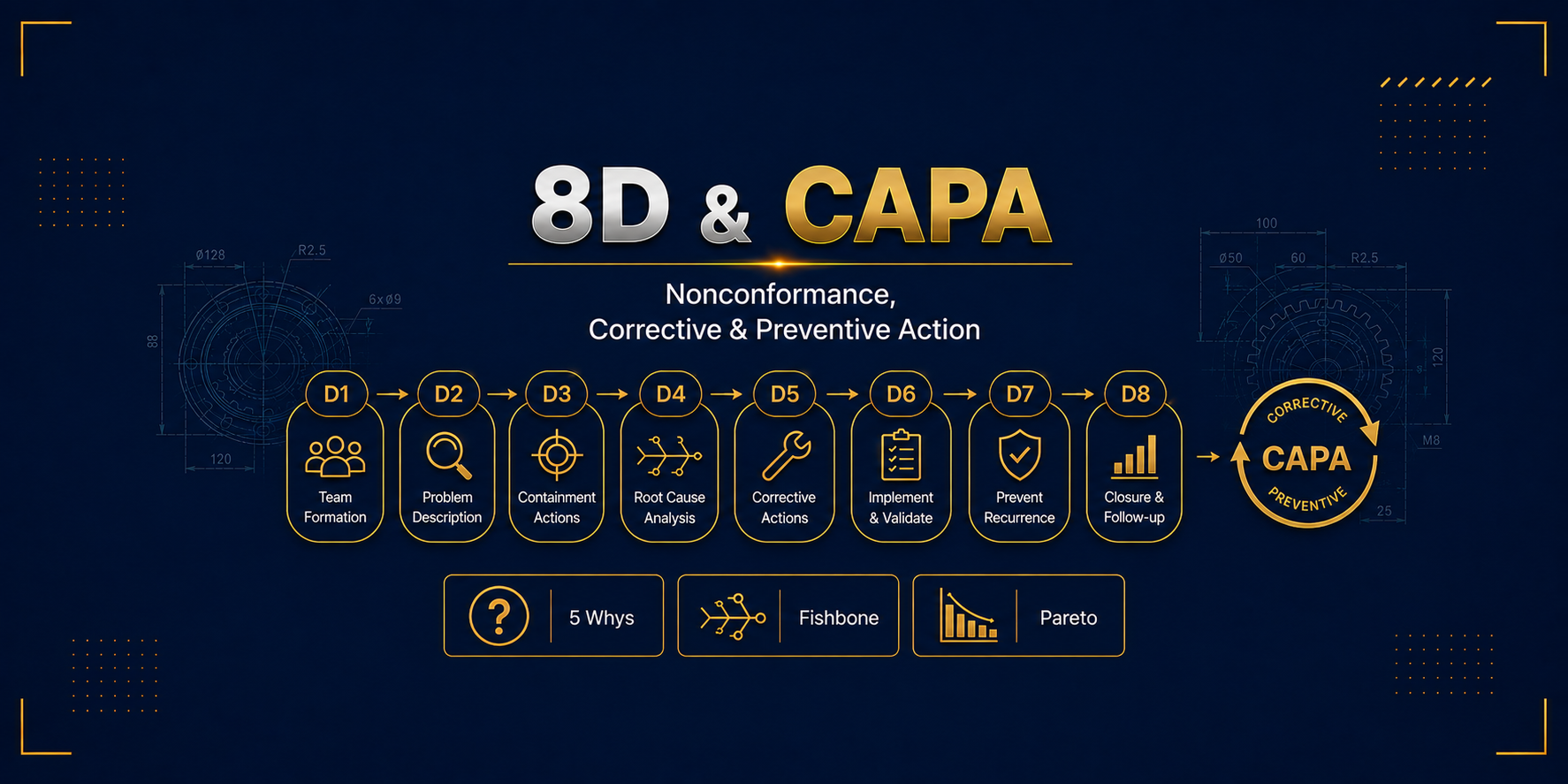
What Are 8D and CAPA? Nonconformance, Corrective and Preventive Action
Short answer: 8D (Eight Disciplines) is a structured, team-based problem-solving methodology that resolves a problem in eight steps (D1–D8), finds the root cause and prevents recurrence. CAPA (Corrective And Preventive Action) is a quality management system requirement: corrective action eliminates the root cause of an existing nonconformance, while preventive action stops a potential nonconformance before it occurs. 8D is one of the strongest frameworks for executing CAPA.
In aerospace and defense manufacturing, a defect recurring “over and over” is unacceptable. That is exactly what 8D and CAPA prevent: they find the root cause of a nonconformance, apply a permanent fix, and ensure the same defect never happens again. This guide covers the 8D steps, the CAPA process, root cause analysis, and why they are mandatory in AS9100 audits.
What Is 8D?
8D (Eight Disciplines) is an eight-step methodology used to systematically solve a quality problem. Its origin is the automotive sector, but today it is widely used in aerospace, defense and general manufacturing. The goal of 8D is not merely to fix the defect but to find the root cause and permanently prevent recurrence.
What Are the 8D Steps (D1–D8)?
| Step | Discipline | Purpose |
|---|---|---|
| D0 | Preparation & emergency response | Recognize the problem, apply immediate protection if needed |
| D1 | Build the team | A cross-functional team to solve the issue |
| D2 | Problem description | Describe the problem in measurable terms |
| D3 | Interim containment | Temporarily protect the customer/production |
| D4 | Root cause analysis | Find the true cause |
| D5 | Permanent corrective action | Choose the fix that eliminates the root cause |
| D6 | Implementation & validation | Apply the fix, verify its effect |
| D7 | Prevent recurrence | Update system/process, prevent spread |
| D8 | Closure & recognition | Acknowledge the team, record lessons learned |
What Is CAPA (Corrective and Preventive Action)?
CAPA is the quality management system’s systematic response to nonconformances. Clause 10.2 of ISO 9001 and AS9100 requires determining the root cause and initiating corrective action when a nonconformance arises.
What Is the Difference Between Corrective and Preventive Action?
- Corrective action: Eliminates the root cause of a nonconformance that has already occurred (reactive).
- Preventive action: Prevents a potential nonconformance before it occurs (proactive). The strongest preventive tool is FMEA.
How Does Nonconformance Management Work?
A typical nonconformance (NCR) flow:
- Detection and recording: The nonconformance is documented.
- Disposition: Use / repair / rework / reject / return.
- Root cause analysis.
- Initiate CAPA: Corrective (and, if needed, preventive) action.
- Verification and closure: Effectiveness is checked; the record is kept traceable.
What Are the Root Cause Analysis Tools?
- 5 Whys: Asking “why?” repeatedly to reach the true cause.
- Fishbone (Ishikawa): Grouping causes under 6M (Man, Machine, Method, Material, Measurement, Environment).
- Pareto analysis: Focusing on the 20% of causes that create 80% of defects.
What Is the Relationship Between 8D and CAPA?
8D is a methodology, while CAPA is a QMS requirement. The D4–D7 steps of 8D (root cause, permanent corrective action, implementation, prevent recurrence) directly satisfy the CAPA process. In short, many companies run their CAPA in 8D format; the two do not conflict — they complement each other.
How Is Nonconformance and CAPA Managed with ERP?
Running nonconformance and CAPA records over email and spreadsheets creates the risk of producing no evidence at audit. The HarmonyERP quality management module makes this process traceable end to end:
- Nonconformance (NCR) recording and disposition flow
- Opening CAPA, assigning owner-deadline and tracking
- Root cause and effectiveness verification records
- Preventive-action link with FMEA
- Single-database integration with production, procurement and inventory
- Audit-ready records for AS9100 and NATO AQAP
For the bigger picture, see: ERP for the defense industry.
Common Mistakes
- Mistaking containment for a permanent fix: D3 only “puts out the fire”; if the root cause isn’t removed, the defect returns.
- Skipping root cause and rushing to a solution: Decisions made without 5 Whys/Ishikawa stay superficial.
- Not verifying effectiveness: Before closing a CAPA, the fix must be proven to work.
- Scattering records: A non-traceable CAPA is a nonconformity at audit.
Frequently Asked Questions (FAQ)
Are 8D and CAPA the same thing? No. 8D is a problem-solving methodology, while CAPA is a QMS requirement; however, 8D is a frequently used framework for executing CAPA.
How many steps does 8D have? Classically it is eight steps, D1–D8; with the preparation step D0 it is sometimes counted as nine.
What is the difference between corrective and preventive action? Corrective action fixes a nonconformance that has occurred (reactive); preventive action prevents a potential one (proactive).
Does AS9100 require CAPA? Yes; ISO 9001 and AS9100 clause 10.2 require nonconformance and corrective action.
What is the advantage of keeping CAPA in ERP? Owner, deadline, root cause and verification are tracked in one place, making it audit-ready and recurrence-preventable.
Conclusion
8D and CAPA resolve nonconformances at their root cause rather than superficially, preventing the same defect from recurring. In aerospace and defense, this discipline is the foundation of both AS9100 compliance and customer trust. The right ERP infrastructure makes the CAPA process traceable and audit-ready.
Want to manage your nonconformance and CAPA processes with HarmonyERP? Request a free demo or request a quote.
Related Posts
All in Quality Management →What Is UID and MIL-STD-130 Part Marking? Unique Identification and Traceability
Quality ManagementCounterfeit Part Prevention (AS5553) and Electronic Component Traceability
Quality ManagementWhat Is Incoming Quality Control and the Inspection (Control) Plan?
Quality ManagementWhat Are APQP and PPAP? Advanced Product Quality Planning and Part Approval
Transform Your Business with HarmonyERP
Manage manufacturing, accounting, inventory and sales from a single platform. Request a demo and see the difference.