
What Is Serial Number Tracking? End-to-End Traceability & Recall in Defense
What is serial number tracking, and how does it differ from lot tracking? End-to-end traceability, recall management, and ERP-based serial tracking in the defense industry.
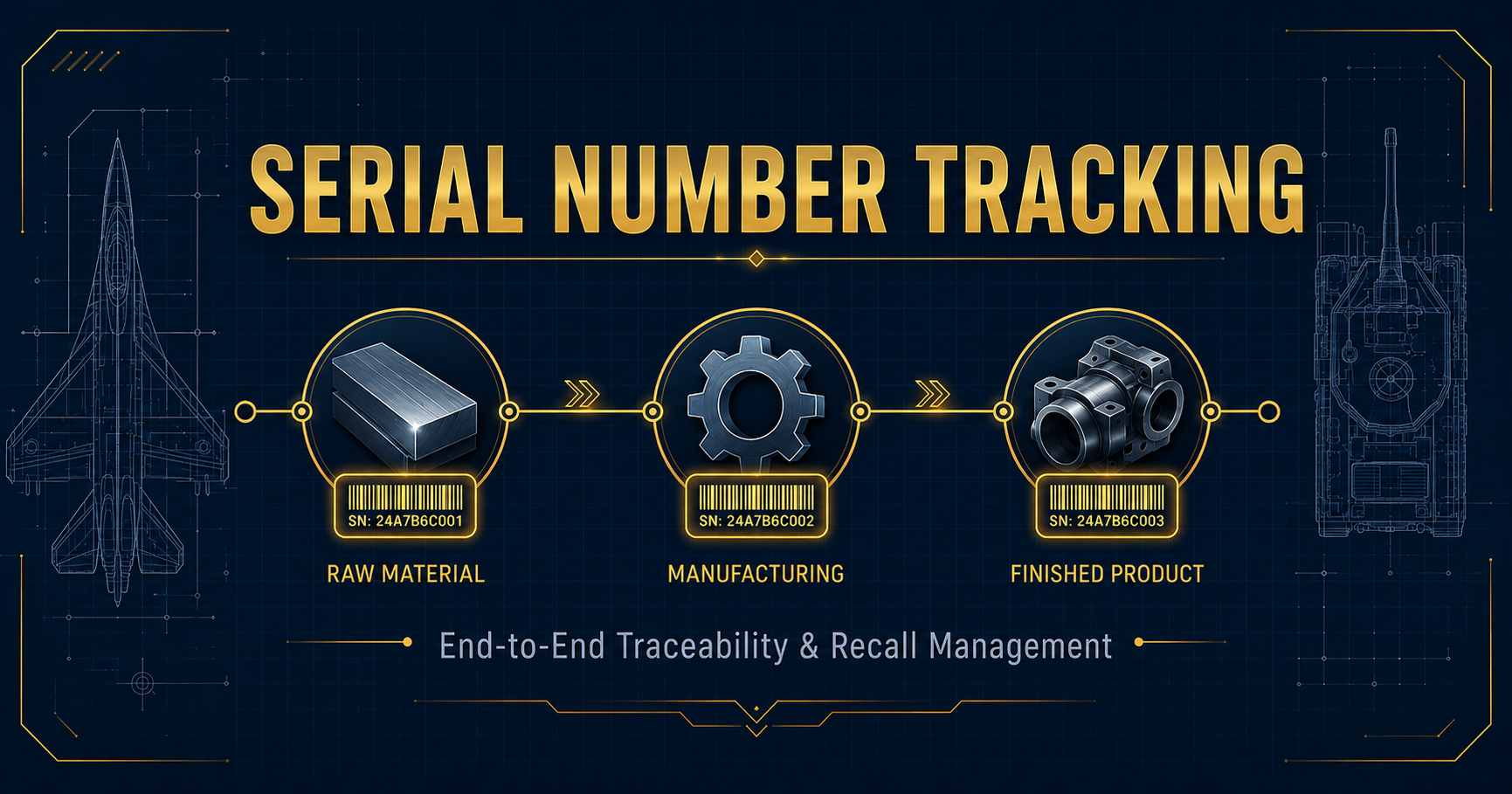
Serial number tracking is the practice of assigning a unique serial number to each individual product and recording its entire history from raw material to final system. Unlike lot (batch) tracking, serial tracking follows each product one by one; it can be queried which raw material lot a part was produced from, which operator processed it on which machine, which tests it passed, and which final system it was assembled into. It is mandatory in sectors that require full traceability, such as defense, aerospace, and medical.
In defense projects, being unable to prove the history of a part is not just an operational problem; it is a direct cause of nonconformity in AS9100 and NATO AQAP audits. This guide explains what serial number tracking is, how it differs from lot tracking, how end-to-end traceability and recall management work, and how this process is managed with an ERP.
What Is Serial Number Tracking?
Serial number tracking is the assignment of a unique identifier to each physical product and the monitoring of that product’s entire life cycle through this identifier. A serial number is like the product’s “identity number”: it stays attached to that product at every stage, from the moment of production to shipment, then to field use, and to recall when necessary.
In the defense industry, a radar module, an avionics board, or a missile subcomponent is tracked by a unique serial number. This way, even years later, it can be established in a single query which production batch a specific system in the field came from, with which supplier’s material, and with which test results it was produced.
What Is the Difference Between Serial Tracking and Lot (Batch) Tracking?
Both methods provide traceability, but the granularity (level of detail) of tracking differs. Lot tracking follows a group of products together, while serial tracking follows each product one by one. For a detailed comparison, see our lot (batch) tracking guide.
| Criterion | Lot (Batch) Tracking | Serial Number Tracking |
|---|---|---|
| Tracking unit | Product group (batch) | Each individual product |
| Granularity | Medium | Highest |
| Typical use | Food, chemicals, textiles | Defense, aerospace, medical |
| Recall scope | Affected batch | Affected individual products |
| Cost/effort | Lower | Higher but more precise |
In the defense industry, the two are often used together: raw materials and consumables are tracked by lot, while critical components and final systems are tracked by serial.
What Is End-to-End Traceability?
End-to-end traceability is the ability to track a product’s history continuously from raw material receipt to final delivery. It has two directions:
- Forward traceability: Finding which products and which final systems a specific raw material lot went into. It answers the question “where was this material used?” when a problem arises in a material.
- Backward traceability: Finding which materials, operations, and tests a specific product in the field went through. It answers the question “where did this come from?” when a problem arises in a product.
Summary: The value of end-to-end traceability emerges in a crisis. When a defect is detected in a component, the difference between being able to list all affected products within minutes and scanning manual records for weeks is decisive in terms of both cost and reputation. In the defense industry, this is often a contractual obligation.
How Does Recall Management Work?
A recall is the process of identifying and collecting affected products when a defect or nonconformity is detected in items that have already reached the field. Effective recall management consists of the following steps:
- Trigger detection: A nonconformity is identified in a raw material lot, an operation, or a test result.
- Impact analysis: From traceability records, all serial numbers affected by that lot or operation are listed.
- Scope determination: It is determined which customers and which systems the affected products went to.
- Action and reporting: The recall is executed, and a full traceability report is produced for the audit.
The speed of this process depends directly on the quality of the traceability records. If serial-level records are not kept, the recall has to cover the entire batch, which means unnecessary cost and reputational loss.
How Is Serial Number Tracking Managed with ERP?
Managing serial-level traceability with spreadsheets becomes impossible as production volume grows; a single broken record invalidates the entire traceability chain. A defense industry ERP makes serial and lot tracking a natural part of the production process.
HarmonyERP provides end-to-end traceability with the real capabilities defined on its defense solution:
- Full serial/lot traceability: Track every component, from raw material to final system, by serial and lot number.
- One-click query: See in a single query which raw material lot a part was produced from, which operator processed it on which machine, which quality tests it passed, and which final system it was assembled into.
- Fast recall: In recall scenarios, report all affected parts and systems within minutes.
- Quality integration: Traceability records are kept linked to incoming/in-process/final quality control and test results; this way, each serial number carries its own quality history.
Because these capabilities work in integration with the inventory, production, and quality modules, traceability becomes not a separate recording burden but an automatic output of production.
Common Mistakes in Serial Number Tracking
- Confusing serial and lot tracking. Critical components should be tracked by serial and consumables by lot; tracking everything with a single method creates either excessive burden or insufficient granularity.
- Thinking of traceability only at shipment. If the chain does not begin at raw material receipt, backward traceability cannot be established.
- Keeping quality data separate from traceability. If the serial number is not linked to test and inspection results, the question “which tests did this product pass?” remains unanswered in an audit.
- Relying on manual records. Manually kept serial records break down as volume grows; a single missing record invalidates the entire chain.
- Not testing the recall scenario in advance. The strength of a traceability system can only be measured in a real recall drill.
Frequently Asked Questions
What is a defense industry ERP?
A defense industry ERP is enterprise resource planning software developed for aerospace and defense manufacturers that require serial/lot-level end-to-end traceability, compliance with strict quality standards such as AS9100 and ISO 9001, and project-based manufacturing and costing. It unifies production, quality, inventory, and procurement processes on a single secure platform. HarmonyERP meets these needs with full serial/lot traceability and an on-premise architecture.
What is the difference between serial tracking and lot tracking?
Lot tracking follows a group of products (a batch) together; serial tracking follows each product one by one with a unique number. Serial tracking provides the highest granularity and is mandatory for critical components in sectors such as defense, aerospace, and medical. Most manufacturers use the two together: consumables by lot, critical components by serial.
Why is end-to-end traceability important?
End-to-end traceability makes it possible to quickly identify all affected products when a problem arises in a product or raw material. In the defense industry, this is a requirement of AS9100 and NATO AQAP audits and is often a contractual obligation. Without traceability, a recall has to cover the entire batch, causing cost and reputational loss.
How does ERP help in the recall process?
Because the ERP keeps serial and lot records tied to production data, when a nonconformity is detected, it lists all affected serial numbers and which systems/customers they went to within minutes. This makes it possible to target only the affected products without unnecessarily expanding the recall scope.
How does HarmonyERP perform serial number tracking?
HarmonyERP tracks every component, from raw material to final system, by serial and lot number. In one click, it queries which raw material lot a part was produced from, which operator and machine processed it, which tests it passed, and which system it was assembled into. In recall scenarios, all affected parts and systems are reported within minutes.
Conclusion
Serial number tracking gives each product a unique identity, making its entire history traceable from raw material to final system; it offers higher granularity than lot tracking and is mandatory for critical components in the defense industry. End-to-end traceability, especially during a recall, provides the power to identify affected products within minutes. Keeping these records manually becomes impossible as volume grows; an ERP system turns traceability into an automatic output of production.
HarmonyERP’s inventory management module runs serial- and lot-level traceability in integration with production and quality data; in recall scenarios, it reports all affected products in a single query. With 20+ years of enterprise software experience, we help aerospace and defense manufacturers set up their traceability processes in an audit-ready way. To see our defense-specific solution live, request a free demo.
Related guides: Defense Industry ERP Solution · Inventory Management Module · What Is Lot (Batch) Tracking?
Transform Your Business with HarmonyERP
Manage manufacturing, accounting, inventory and sales from a single platform. Request a demo and see the difference.