
Counterfeit Part Prevention (AS5553) and Electronic Component Traceability
What are counterfeit part prevention and AS5553? Electronic component counterfeiting risk, detection methods, and approved-supplier & traceability management with ERP.
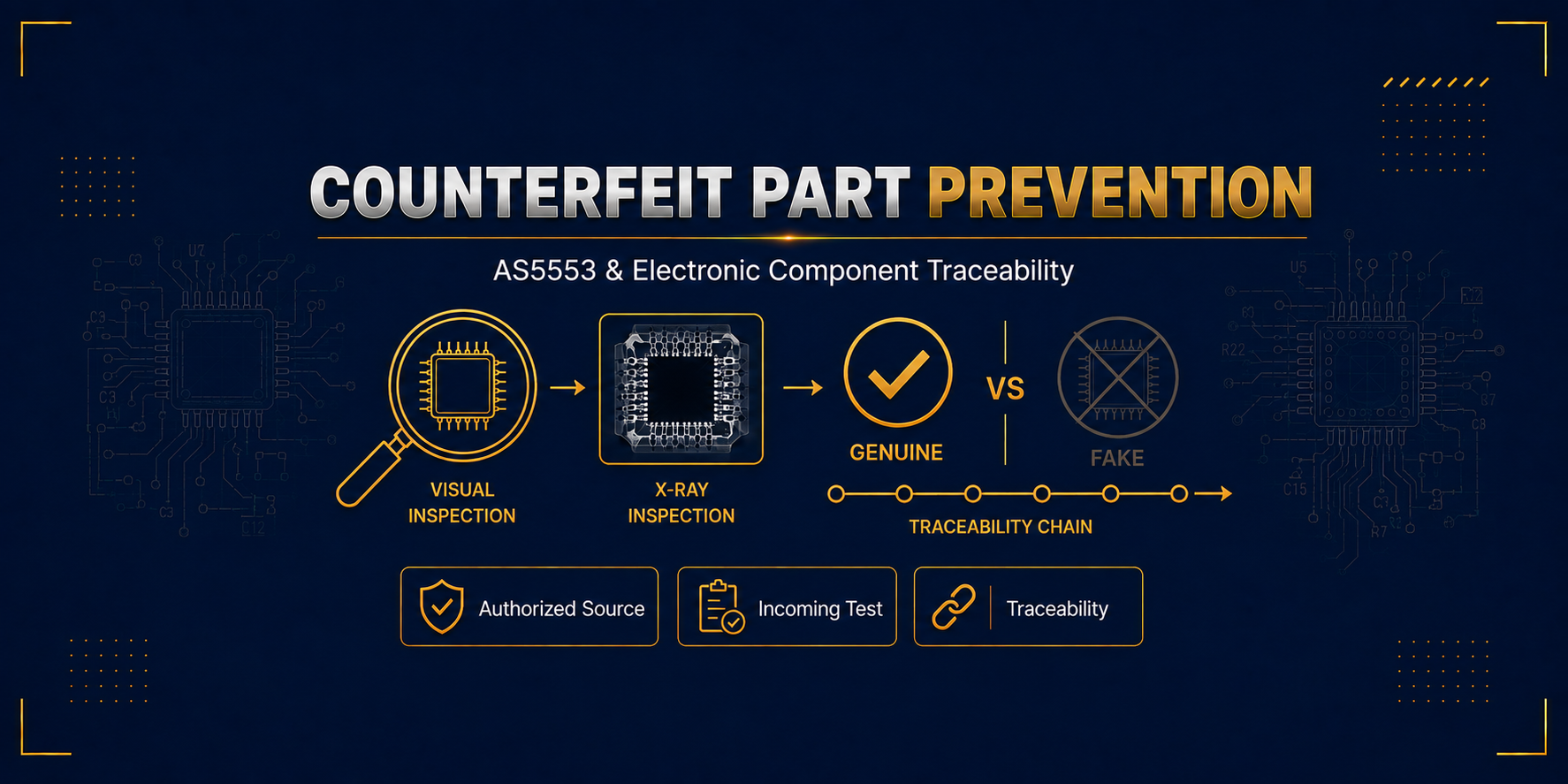
Counterfeit Part Prevention (AS5553) and Electronic Component Traceability
Short answer: Counterfeit part prevention is a risk-management discipline that stops fake, remarked or out-of-spec components — especially electronic ones — from entering the supply chain. AS5553 is the SAE standard that defines the rules for avoiding, detecting, mitigating and disposing of this risk in aerospace and defense. The core protections are sourcing from authorized channels, risk-based supplier assessment, incoming inspection, and end-to-end traceability.
A single counterfeit chip inside a defense system can cause a critical failure in the field. Counterfeit part prevention and AS5553 manage exactly this risk: they ensure electronic and mechanical components are genuine, traceable and compliant with requirements. This guide covers what a counterfeit part is, how it enters the supply chain, how AS5553 prevents it, and how an ERP strengthens the process.
What Is a Counterfeit Part?
A counterfeit part is a component whose source, identity, manufacturer or characteristics are misrepresented, or that is copied without authorization. The most common example is electronic components: a used chip cleaned and sold as “new,” having its marking changed (remarking), or being placed on the market with fake documentation. A counterfeit part may look genuine but carries risk in performance, reliability and safety.
What Is AS5553?
AS5553 is the aerospace-defense standard published by SAE International that defines requirements for the avoidance, detection, mitigation and disposition of counterfeit electronic parts. It provides a framework for buyers and integrators; the complementary standard for independent distributors is AS6081. Together with the AS9100 quality system, AS5553 forms the foundation of supply-chain security.
How Do Counterfeit Parts Enter the Supply Chain?
- Obsolescence: Turning to the gray market for a discontinued component is the biggest risk.
- Unauthorized distributors: Buying from stock of uncertain origin.
- Remarking: Marking a lower-grade or used part as a higher class.
- False documentation: Fake certificates of conformity (CoC).
What Are the Types of Counterfeit Parts?
| Type | Description |
|---|---|
| Recycled | A used part cleaned and sold as new |
| Remarked | A part whose marking/grade has been altered |
| Cloned / copy | An unauthorized imitation component |
| Out-of-spec | A part that failed testing and was diverted |
| Falsely documented | A genuine part with falsified documents |
How Does AS5553 Prevent Counterfeit Parts?
- Source from authorized channels: Priority is the original component manufacturer (OCM) or an authorized/franchised distributor.
- Risk-based supplier assessment: Approved supplier list and supplier audits.
- Incoming inspection and test: Verifying the incoming part via incoming quality control.
- Traceability: Recording each part’s source at serial/lot level.
- Reporting: Reporting suspect parts to industry databases such as GIDEP.
- Quarantine and disposition: Isolating suspect parts and preventing their re-entry into circulation.
What Are the Counterfeit Detection Methods?
- Visual inspection: Examining marking, surface and pin condition.
- X-ray: Checking internal structure and connections.
- Decapsulation: Opening the chip to verify the die.
- Electrical testing: Functional and parametric verification.
Counterfeit Prevention and Traceability with ERP
Counterfeit prevention requires procurement, supplier quality, incoming inspection and traceability to work together. Managing this chain with scattered systems creates gaps. HarmonyERP unifies the process on one platform:
- Approved supplier list and supplier quality management (procurement integration)
- Incoming inspection and quarantine flow at goods receipt (quality module)
- Serial/lot-level traceability of every part
- Suspect-part handling via nonconformance and CAPA
- Storing source, documents and certificates in a single record
Common Mistakes
- Sourcing on price alone: Cheap buying from the gray market is the biggest counterfeit risk.
- Skipping document verification: A fake CoC contaminates the chain if not checked.
- Not establishing traceability: A part of unknown origin cannot be recalled.
- Not reporting suspect parts: An unreported counterfeit keeps circulating in the industry.
Frequently Asked Questions (FAQ)
What does AS5553 cover? It covers requirements for avoiding, detecting, mitigating and disposing of counterfeit electronic parts in aerospace-defense.
Where are counterfeit parts most common? Most commonly in gray-market sourcing of obsolete electronic components.
What is the most effective way to prevent counterfeit parts? Sourcing from the original manufacturer or an authorized distributor, plus end-to-end traceability.
What is the difference between AS5553 and AS6081? AS5553 targets buyers/integrators, while AS6081 is a complementary standard for independent distributors.
How does ERP help with counterfeit prevention? By unifying approved suppliers, incoming inspection and serial/lot traceability in one system, it prevents suspect parts from entering production.
Conclusion
Counterfeit part prevention and AS5553 are the foundation of protecting the reliability of defense electronics: with authorized sourcing, incoming inspection and traceability, a fake component is stopped at the door. The right ERP infrastructure unifies the supplier-quality-traceability chain and manages this risk systematically.
Want to manage your supplier quality and traceability processes with HarmonyERP? Request a free demo or request a quote.
Related Posts
All in Quality Management →What Is UID and MIL-STD-130 Part Marking? Unique Identification and Traceability
Quality ManagementWhat Is Incoming Quality Control and the Inspection (Control) Plan?
Quality ManagementWhat Are APQP and PPAP? Advanced Product Quality Planning and Part Approval
Quality ManagementWhat Are 8D and CAPA? Nonconformance, Corrective and Preventive Action
Transform Your Business with HarmonyERP
Manage manufacturing, accounting, inventory and sales from a single platform. Request a demo and see the difference.