
What Is Incoming Quality Control and the Inspection (Control) Plan?
What are incoming quality control and the inspection/control plan, and how are they set up? Acceptance sampling (AQL), incoming material inspection, and supplier quality with ERP.
What Is Incoming Quality Control and the Inspection (Control) Plan?
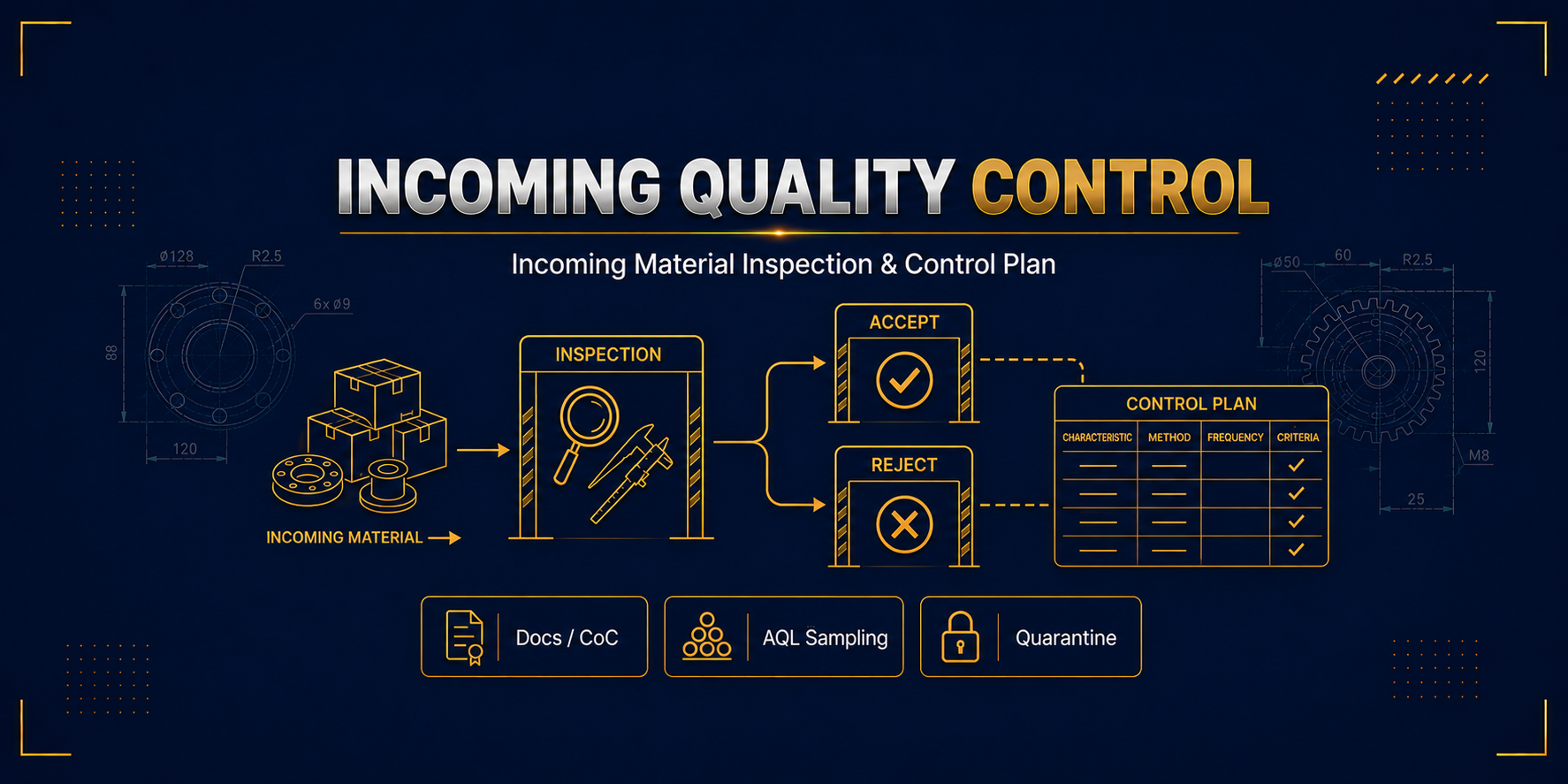
Short answer: Incoming Quality Control (IQC) is the inspection of raw materials and parts arriving from suppliers, against defined acceptance criteria, before they enter production. The inspection (control) plan is the document that defines which characteristic is checked, by which method, at which frequency, and against which acceptance criterion. In defense and aerospace, together these form the first line of defense against a defective or counterfeit part entering production.
In aerospace and defense manufacturing, the cheapest place to catch a defect is the moment the part comes through the door. That is exactly what incoming quality control and the control plan provide: by inspecting incoming material against a defined plan, they prevent a nonconforming or counterfeit component from reaching the production line and the final product. This guide covers how incoming quality control works, what a control plan contains, and how an ERP secures the process.
What Is Incoming Quality Control?
Incoming Quality Control (IQC) is the quality stage where purchased raw materials, semi-finished goods and components are inspected before being accepted into the warehouse/production. The goal is to stop nonconforming material at the source and ensure that only parts meeting requirements enter production. Incoming control covers dimensional measurement, visual inspection, material/certificate of conformity (CoC) checks and, when needed, functional testing.
What Is the Inspection (Control) Plan?
An inspection or control plan is the document that defines how a product’s or process’s quality characteristics are controlled. It covers incoming, in-process and final stages. A good control plan clarifies five things for each characteristic: what is checked, by which method, with which equipment, at which frequency, and which reaction plan applies to a nonconformance.
What Does a Control Plan Contain?
| Field | Description |
|---|---|
| Characteristic | Feature to measure (dimension, hardness, appearance…) |
| Acceptance criterion | Tolerance / specification limit |
| Measurement method | Caliper, micrometer, visual, test device |
| Equipment | The calibrated device used |
| Frequency / sampling | Every part, every lot, AQL sampling |
| Reaction plan | What to do on a nonconformance (CAPA) |
How Does Incoming Quality Control Work Step by Step?
- Goods receipt and quarantine: The incoming shipment is recorded and held in quarantine until approved.
- Document check: The delivery note, material certificate and certificate of conformity (CoC) are verified.
- Measurement per the inspection plan: The characteristics in the control plan are inspected.
- Acceptance sampling: If needed, sampling is done per AQL.
- Disposition: Accept / conditional accept / reject / return.
- Record and traceability: Results are recorded at lot/serial level; a CAPA is opened on a nonconformance.
What Are Acceptance Sampling and AQL?
Measuring every single part is often impractical. Acceptance sampling takes a defined number of samples from a lot and makes a decision about the whole lot. AQL (Acceptable Quality Level), per the ISO 2859 standard, determines the sample size and accept/reject numbers. For critical defense parts, 100% inspection is often preferred.
Why Is Incoming Quality Control Critical in the Defense Industry?
- Single-source and critical parts: A nonconforming part can halt an entire project across the supply chain.
- Counterfeit-part risk: Especially for electronic components, incoming control is the first line of defense.
- Traceability: AS9100 requires keeping the source and inspection record of every part.
Managing Incoming Quality and Control Plans with ERP
Incoming quality control requires procurement, inventory and quality processes to work together. Running them in separate systems creates risks such as quarantined material being used by mistake. The HarmonyERP quality management module unifies this process on one platform:
- Control plans and characteristic-based inspection records
- Quarantine/accept-reject flow at goods receipt (inventory integration)
- Supplier quality management and certificate tracking
- Calibrated measurement device linkage
- Nonconformance and CAPA integration
- Lot/serial-level traceability
For the bigger picture, see: ERP for the defense industry.
Common Mistakes
- Acceptance without quarantine: Material shelved without inspection can slip into production.
- Skipping document checks: Without a material certificate (CoC), traceability breaks.
- Not updating the control plan: When a revision changes, acceptance criteria change too.
- Leaving nonconformances unrecorded: Without a CAPA, supplier performance cannot be measured.
Frequently Asked Questions (FAQ)
What is the difference between incoming and final inspection? Incoming inspection checks arriving material before production; final inspection checks the finished product before shipment.
Are the control plan and inspection plan the same thing? Largely yes; the control plan defines all control points of the product and process, while the inspection plan defines the details of a specific inspection.
What is AQL? Acceptable Quality Level; a statistical method per ISO 2859 that determines sample size and accept/reject criteria.
Is 100% inspection required in defense? For critical and safety-related parts it is often preferred; sampling may also be used depending on the risk level.
What is the advantage of keeping incoming quality control in ERP? Procurement, quarantine, inspection and supplier performance are tracked in one place, and use of nonconforming material is systematically prevented.
Conclusion
Incoming quality control and the control plan catch defects at the cheapest and earliest point — while the material is still at the door. In aerospace and defense, this discipline is the first line of defense against counterfeit and nonconforming parts. The right ERP infrastructure unifies procurement-quality-inventory processes and makes this control traceable and reliable.
Want to manage your incoming and supplier quality processes with HarmonyERP? Request a free demo or request a quote.
Related Posts
All in Quality Management →What Is UID and MIL-STD-130 Part Marking? Unique Identification and Traceability
Quality ManagementCounterfeit Part Prevention (AS5553) and Electronic Component Traceability
Quality ManagementWhat Are APQP and PPAP? Advanced Product Quality Planning and Part Approval
Quality ManagementWhat Are 8D and CAPA? Nonconformance, Corrective and Preventive Action
Transform Your Business with HarmonyERP
Manage manufacturing, accounting, inventory and sales from a single platform. Request a demo and see the difference.