
Defense Industry Supply Chain Management: Long-Lead Parts and Single-Source Risk
How is the defense industry supply chain managed? Long-lead parts, single-source risk, counterfeit part prevention, and ERP-based procurement management guide.
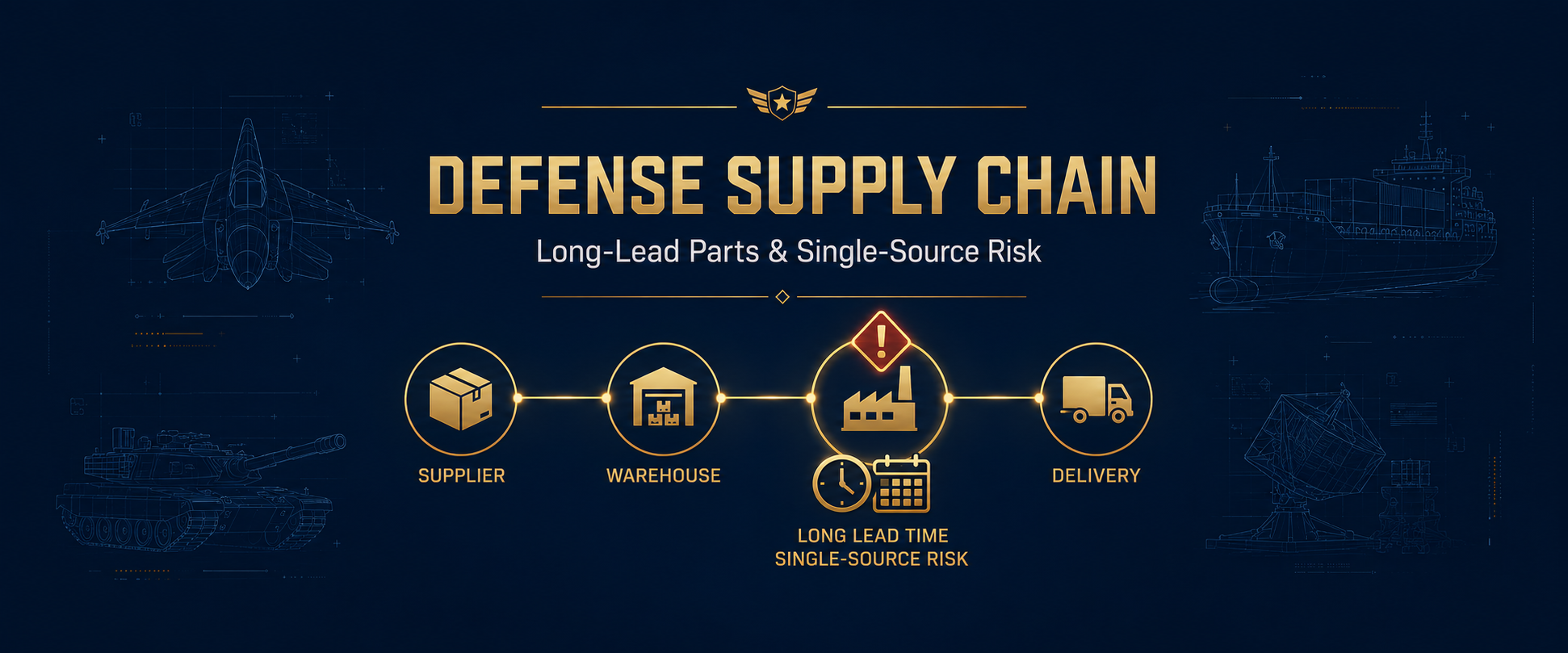
Defense industry supply chain management is a process that covers the timely procurement of long-lead and critical components, the management of supplier risks, and the preservation of traceability for all materials. Unlike commercial sectors, lead times here are measured in months and sometimes years; many critical components have only one approved supplier, and changing suppliers requires customer approval. For this reason, supply chain in defense is a matter of continuity and risk management before cost.
In a defense project, the entire production plan can depend on the lead time of a single critical component. Ordering a long-lead part late shifts the milestone schedule by months. This guide explains how defense industry supply chain management works, how long-lead parts and single-source risk are managed, and how this process is controlled with an ERP.
Why Is the Supply Chain Different in the Defense Industry?
The defense supply chain differs from commercial manufacturing in four key respects:
- Long lead times: For special alloys, avionics components, and military-grade electronic parts, lead times can extend for months, sometimes beyond a year.
- Approved supplier requirement: Critical components can only be purchased from suppliers approved by the customer or prime contractor; changing a supplier requires re-approval.
- Traceability requirement: The origin, lot information, and certificates of every material must be on record.
- Counterfeit part risk: Especially in electronic components, counterfeit parts are one of the most serious risks in the defense supply chain.
These differences make it essential that procurement decisions in defense be based not only on price but on continuity, conformity, and risk.
How Are Long-Lead Parts Managed?
A long-lead part is a component that takes months to receive after the order is placed and therefore directly determines the project schedule. If these parts are not managed, the project waits even if the rest of production is ready.
Steps to follow for effective management:
- Early identification: Long-lead items are identified from the bill of materials while the project is still in the design stage.
- Early planning with MRP: Material Requirements Planning calculates the order date backward, taking lead times into account.
- Long-lead release: Early orders can be opened for critical items before the design is fully finalized.
- Commitment with the supplier: Delivery is secured with a long-term contract or capacity reservation.
- Continuous tracking: Order status is monitored in sync with the production plan and milestone schedule.
Summary: What is critical with long-lead parts is seeing the problem early. If a component with a 9-month lead time is noticed three months before the project deadline, no expediting method can close that gap. This is why MRP calculating lead times over a correctly defined bill of materials is the foundation of schedule safety in defense projects.
What Is Single-Source Risk?
Single-source risk is the continuity risk that arises when a component can be procured from only one supplier. This situation is common in the defense industry, because components are produced to special specifications and supplier approval processes are lengthy.
The main consequences of single-source risk:
- A disruption at the supplier (capacity, financial trouble, export restriction) directly halts production.
- The buyer’s leverage in price negotiation is limited.
- Because changing suppliers requires customer approval and requalification, a quick solution is not possible.
Ways to reduce this risk include qualifying alternative suppliers, holding safety stock for critical items, and regularly monitoring supplier financial health. At this point, a systematic supplier performance evaluation approach is a critical tool.
Traceability and Counterfeit Part Risk in the Defense Supply Chain
In the defense supply chain, the origin of every material must be provable. There are two reasons for this: the traceability requirements of standards such as AS9100 and NATO AQAP, and counterfeit part risk.
Counterfeit parts are a serious threat, particularly in military-grade electronic components; a counterfeit component reaching the field jeopardizes both mission success and safety of life. To manage this risk:
- Materials are purchased only from the approved supplier list.
- A certificate of conformity (CoC) and origin document are archived for each batch.
- Verification is performed at incoming quality control and results are recorded by lot.
How Is the Defense Supply Chain Managed with ERP?
Managing long lead times, approved supplier lists, certificate archives, and single-source risk with spreadsheets becomes unsustainable as projects grow. A defense industry ERP unites procurement processes with the production plan and quality data on a single platform.
HarmonyERP’s procurement management module supports the defense supply chain with the following capabilities:
- MRP-based automatic requisitions: Material Requirements Planning automatically generates purchase requests from project needs and lead times.
- Long-lead item tracking: Lead times for critical components are defined and order dates are calculated according to the project schedule.
- Approved supplier management: Suppliers are managed by approval status, certificates, and performance; alternative suppliers are kept on record.
- Supplier performance evaluation: Supplier scorecards are created based on delivery time, quality, and conformity criteria.
- Traceability and certificate records: Every incoming material is recorded by lot/serial; certificates of conformity are linked to the relevant batch.
Because these capabilities work in integration with the production, inventory, and quality modules, procurement delays are reflected in the production plan immediately and risk is seen early.
Common Mistakes in Defense Supply Chain Management
- Planning long-lead items too late. If critical components are not identified at the start of the project, the schedule slips irrecoverably.
- Accepting single-source risk. If no alternative supplier qualification effort is started, a single disruption at the supplier halts production.
- Selecting suppliers on price alone. In defense, delivery reliability and conformity are more decisive than unit price.
- Not linking certificates to batches. If conformity and origin documents are not linked to the relevant lot, traceability cannot be proven in an audit.
- Not measuring supplier performance. Without regular scorecards, problematic suppliers are only noticed when a crisis erupts.
Frequently Asked Questions
What is defense industry supply chain management?
Defense industry supply chain management is the process covering the timely procurement of long-lead and critical components, working with approved suppliers, managing single-source risk, and preserving the traceability of all materials. Unlike commercial procurement, continuity, conformity, and risk management are more decisive than price.
What is a long-lead part?
A long-lead part is a component whose time from order to delivery is long, extending over months (sometimes beyond a year). In defense, special alloys, avionics, and military-grade electronic parts are typical examples. Because these items directly determine the project schedule, they must be identified during the design stage and ordered early.
What is single-source risk?
Single-source risk is the continuity risk arising from a component being procurable from only one approved supplier. A disruption at the supplier directly halts production, and because changing suppliers requires customer approval, a quick solution is not possible. It is mitigated with alternative supplier qualification and safety stock.
How is counterfeit part risk prevented in the defense supply chain?
Counterfeit part risk is reduced by purchasing only from the approved supplier list, archiving a certificate of conformity (CoC) and origin document for each batch, performing verification at incoming quality control, and recording results by lot. NATO AQAP and AS9100 standards make these processes mandatory.
How does HarmonyERP manage the defense supply chain?
HarmonyERP generates automatic purchase requests from project needs with MRP and plans order dates by taking lead times into account. It manages approved suppliers, their certificates, and performance scorecards, and makes incoming materials traceable by lot/serial. Procurement delays are reflected in the production plan immediately.
Conclusion
Supply chain management in the defense industry differs fundamentally from commercial procurement because of long lead times, approved supplier requirements, single-source risk, and the threat of counterfeit parts. The key to success is identifying critical components at the start of the project, planning them early with MRP, and systematically monitoring supplier risks. Running these processes manually increases schedule and compliance risk as projects grow; an ERP system keeps procurement in sync with the production plan and quality data.
HarmonyERP’s procurement management module brings your defense supply chain under control with MRP-based automatic requisitions, approved supplier management, performance scorecards, and lot-level traceability. With 20+ years of enterprise software experience, we help aerospace and defense manufacturers set up their procurement processes in an audit-ready and delivery-ready way. To see our defense-specific solution live, request a free demo.
Related guides: Defense Industry ERP Solution · Procurement Management Module · Supplier Performance Evaluation
Transform Your Business with HarmonyERP
Manage manufacturing, accounting, inventory and sales from a single platform. Request a demo and see the difference.