
What Is UID and MIL-STD-130 Part Marking? Unique Identification and Traceability
What are UID and MIL-STD-130 part marking? Unique identification (UII), Data Matrix marking methods, the IUID Registry, and serial number traceability with ERP.
What Is UID and MIL-STD-130 Part Marking? Unique Identification and Traceability
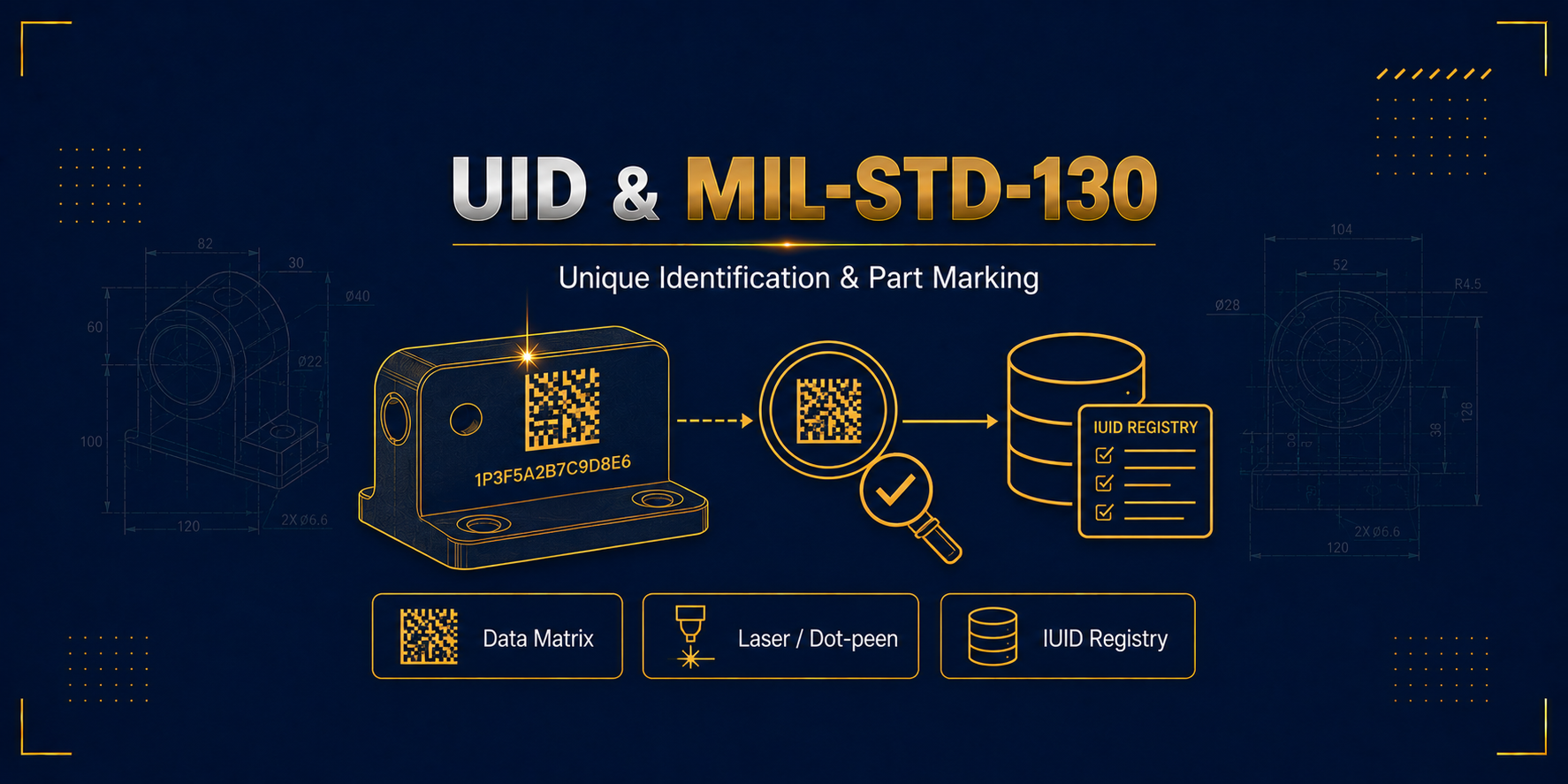
Short answer: UID (Unique Identification) is a system that assigns a permanent, machine-readable, unique identity (UII) to a part so it can be tracked throughout its life cycle. MIL-STD-130 is the U.S. Department of Defense (DoD) standard that defines how this marking is done — usually with a 2D Data Matrix code. The goal is for each part to physically carry its “who, what, from where” information and be tracked through a central registry (the IUID Registry).
To track each of the thousands of parts in a defense system for its entire life, every part must have a unique identity. That is exactly what UID and MIL-STD-130 provide: by marking a part physically with a permanent, unique code, they make it traceable from production to maintenance. This guide covers what UID is, MIL-STD-130’s marking rules, and how an ERP manages this traceability.
What Is UID (Unique Identification)?
UID (Unique Identification), or IUID (Item Unique Identification), is the marking of an item with a globally unique identity that does not change over its life. This identity is called the UII (Unique Item Identifier). Thanks to the UII, a part can be traced with a single reference — from which manufacturer and serial number it was produced, through to maintenance and disposal.
What Is MIL-STD-130?
MIL-STD-130 is the U.S. Department of Defense standard for “Identification Marking of U.S. Military Property.” It specifies how parts are marked: a 2D Data Matrix (ECC200) code, human-readable information and marking methods. This standard defines the physical-marking side of the UID program.
How Is the UII Constructed?
The UII is built from components that ensure uniqueness. There are two common constructs:
| Construct | Content |
|---|---|
| Construct 1 | Enterprise identifier (e.g., CAGE/DUNS) + serial number |
| Construct 2 | Enterprise identifier + original part number + serial number |
Both constructs guarantee that the part is unique worldwide.
What Are Data Matrix and the Marking Methods?
The UII is usually applied to the part as a 2D Data Matrix code. Common marking methods:
- Laser marking: Permanent, high-resolution; common on metal and plastic.
- Dot-peen: Durable mechanical indentation; preferred on heavy parts.
- Label: Permanent adhesive label; when marking would damage the part.
After marking, the code must be verified for readability (e.g., ISO/IEC 15415 quality grade).
What Is the IUID Registry?
The IUID Registry is the DoD’s central database holding the UII records of all marked items. When a part is marked, its record is entered into this system, so the part can be tracked centrally throughout the supply chain and maintenance processes.
When Is UID/MIL-STD-130 Required?
- DoD contracts: Mandatory for items above a certain value threshold or that are critical/serious.
- Configuration-controlled parts: Items requiring configuration management.
- Systems whose maintenance and life cycle are tracked.
- Supply chains with high counterfeit risk.
Managing UID and Traceability with ERP
UID marking requires serial/lot management, inventory and barcode processes to work together. HarmonyERP unifies this traceability on one platform:
- Serial/lot-level part identity and traceability
- Inventory and movement records via barcode/Data Matrix
- Part identity linked to configuration and revision
- Source and marking records against counterfeit risk (AS5553)
- End-to-end records from production to shipment
Common Mistakes
- Not verifying marking quality: An unreadable Data Matrix breaks traceability.
- Building the UII incorrectly: If uniqueness is broken, the record is rejected.
- Skipping the registry entry: Physical marking is incomplete without the record.
- Leaving marking to the end of production: Traceability must be built throughout the process.
Frequently Asked Questions (FAQ)
Are UID and serial number the same thing? No. A serial number is unique within a manufacturer; the UII is made globally unique by combining it with the enterprise identifier.
Which code does MIL-STD-130 use? Mostly a 2D Data Matrix (ECC200) code, accompanied by human-readable information.
What is the IUID Registry? The DoD’s central database that holds the UII records of marked items.
Must every part be marked? No; it is usually determined by value threshold, criticality or contract requirement.
How does ERP help with UID traceability? By unifying serial/lot identity, barcode and configuration in one system, it makes the part traceable from production to maintenance.
Conclusion
UID and MIL-STD-130 are the foundation for tracking every part throughout its life in defense: a part marked with a permanent, unique code is followed by a single identity from production to maintenance. The right ERP infrastructure unifies serial/lot traceability with the marking and record process, making this traceability reliable.
Want to manage your traceability and part-identity processes with HarmonyERP? Request a free demo or request a quote.
Related Posts
All in Quality Management →Counterfeit Part Prevention (AS5553) and Electronic Component Traceability
Quality ManagementWhat Is Incoming Quality Control and the Inspection (Control) Plan?
Quality ManagementWhat Are APQP and PPAP? Advanced Product Quality Planning and Part Approval
Quality ManagementWhat Are 8D and CAPA? Nonconformance, Corrective and Preventive Action
Transform Your Business with HarmonyERP
Manage manufacturing, accounting, inventory and sales from a single platform. Request a demo and see the difference.