
What Is FMEA? How to Perform Failure Mode and Effects Analysis Step by Step
What is FMEA, and how is it done? Failure Mode and Effects Analysis, RPN calculation (Severity × Occurrence × Detection), DFMEA/PFMEA difference, and a step-by-step guide.
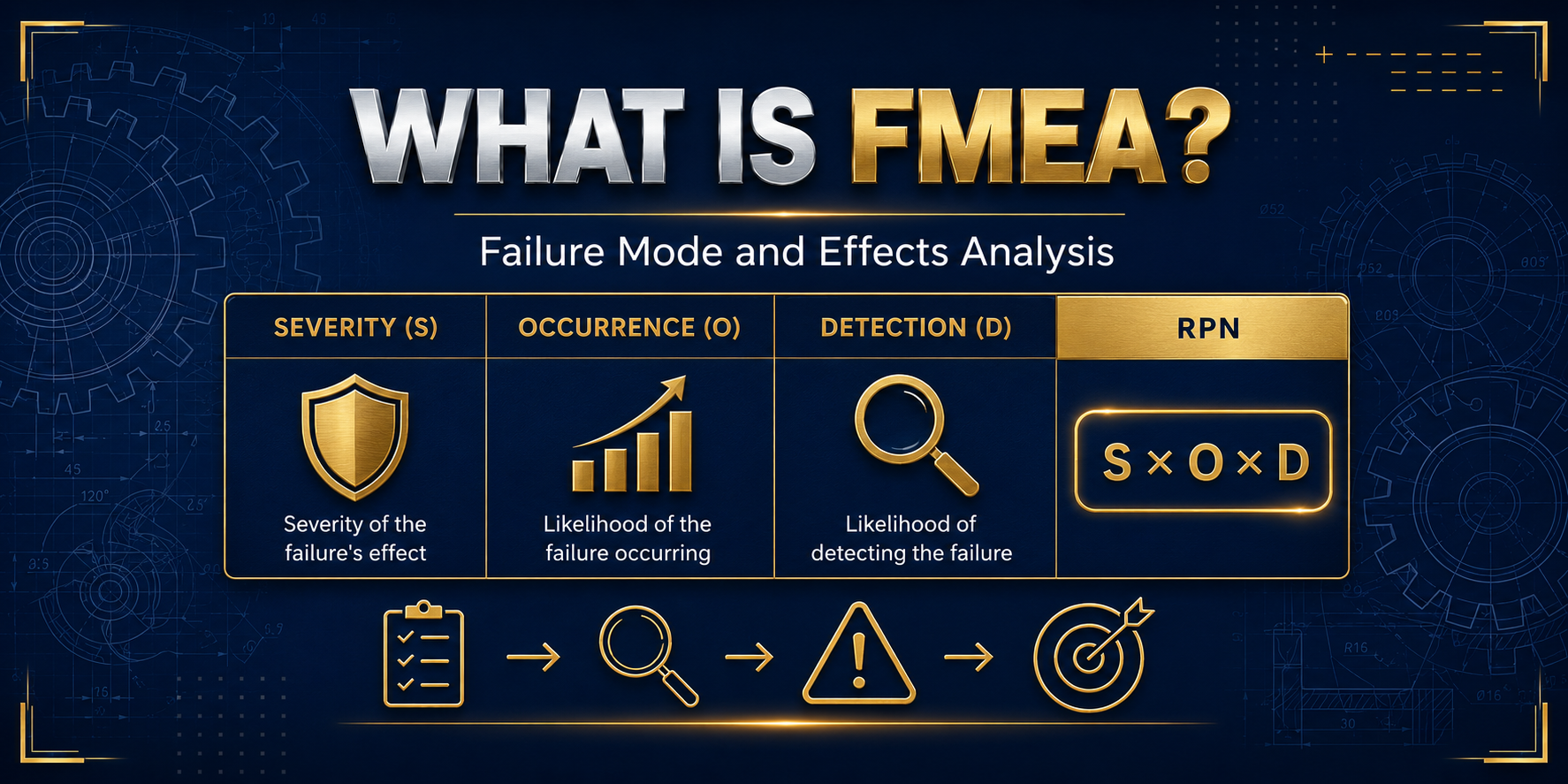
FMEA (Failure Mode and Effects Analysis) is a quality method that identifies potential failures that may occur in a product or process in advance and systematically evaluates their possible effects and risks. For each failure, severity, occurrence, and detection scores are assigned; the product of these three values, the Risk Priority Number (RPN), is calculated to determine which risks to prioritize. It is a mandatory preventive quality tool in the automotive (IATF 16949) and aerospace-defense (AS9100) sectors.
Controlling quality after a defect has occurred is expensive; the real goal is to foresee the defect before it even happens. FMEA does exactly this: it catches risks on paper before they reach production or the field. This guide explains what FMEA is, its types, how RPN is calculated, and how to perform an FMEA analysis step by step with an example.
What Is FMEA?
FMEA (Failure Mode and Effects Analysis) is a structured, preventive quality method that identifies in advance all the possible ways a design or process could fail and prioritizes the effect and risk of each. Its core logic rests on three questions: What could go wrong? What would its effect be? How would we detect it in advance?
FMEA is a proactive rather than reactive tool. Instead of correcting a failure after it occurs, it aims to reduce, from the outset, the likelihood of the failure occurring and the risk of it passing undetected. In this respect, it is a mandatory component of the AS9100 quality management system in sectors such as defense and aerospace, where the margin of error must be near zero.
What Are the Types of FMEA?
FMEA is divided into different types according to the area in which it is applied. The two most common are design and process FMEA:
- DFMEA (Design FMEA): Analyzes potential failures during the product’s design stage. It focuses on the question “under what conditions does this part design fail?”
- PFMEA (Process FMEA): Analyzes potential failures in the production or assembly process. It focuses on the question “in what situation does this operation lead to defective production?”
- System FMEA: Analyzes failures arising from the interaction of multiple subsystems.
- Service FMEA: Analyzes failures in after-sales service and maintenance processes.
In defense projects, DFMEA and PFMEA are usually used together; design risks and production risks are addressed separately.
How Is the Risk Priority Number (RPN) Calculated?
The heart of FMEA is assigning a risk score to each potential failure. This score is found by multiplying three factors:
RPN = Severity (S) × Occurrence (O) × Detection (D)
Each of the three factors is usually scored from 1 to 10:
| Factor | What it measures | Scoring (1 → 10) |
|---|---|---|
| Severity | Seriousness of the failure’s effect | 1 = very minor effect → 10 = critical / safety risk |
| Occurrence | Frequency of the failure | 1 = very rare → 10 = very frequent |
| Detection | Ease of detecting the failure | 1 = easily detected → 10 = almost undetectable |
For example, if a failure has a severity of 8, an occurrence of 4, and a detection of 5:
RPN = 8 × 4 × 5 = 160
The higher the RPN value, the more that failure must be prioritized. An important point: the detection score works in reverse — the harder a failure is to detect, the higher the score, because an undetectable failure is riskier.
Summary: RPN is a prioritization tool that determines which risk to address first; it is a relative comparison measure, not an absolute threshold. Preventive action is planned for failures with high RPN, and the RPN is recalculated after the action to measure improvement. In modern approaches (AIAG-VDA), an Action Priority (AP) matrix is also used instead of RPN.
How Is FMEA Performed Step by Step?
An FMEA analysis proceeds in a structured sequence. The typical steps are:
- Define the scope: Define the boundaries of the product, process, or system to be analyzed.
- List the functions: Identify the functions the product or process is supposed to perform.
- Identify failure modes: List the ways (failure modes) each function could fail.
- Evaluate effects and severity: Determine the possible effects of each failure and the severity score (S).
- Evaluate causes and occurrence: Score the possible causes of each failure and its occurrence (O).
- Evaluate current controls and detection: Determine the existing controls that catch the failure and the detection score (D).
- Calculate RPN: Calculate the risk priority number with S × O × D.
- Plan preventive action: Define action for high-RPN failures and assign an owner and deadline.
- Reassess: Recalculate the RPN after the action to measure improvement.
FMEA is not a document completed once; it is a living document updated as the process or design changes.
The Role of FMEA in Defense and Automotive
FMEA is mandatory by standard in two major sectors. In automotive, IATF 16949 and APQP/PPAP processes require design and process FMEA. In defense and aerospace, AS9100 requires FMEA as a mandatory part of risk management. In both sectors, FMEA is not just a document but a quality record presented as evidence in supplier audits and customer approval processes.
For this reason, managing FMEA in a system tied to production and quality data — rather than on paper or scattered spreadsheets — is becoming increasingly critical.
How Is FMEA Managed with ERP?
Running FMEA analyses with spreadsheets makes it difficult to track updates and close actions; when a design changes, the related FMEA is often left un-updated. A defense industry ERP makes FMEA a natural part of quality processes.
HarmonyERP’s quality management module supports FMEA and risk management with the following capabilities:
- FMEA and risk analysis: Record potential failure modes, enter severity/occurrence/detection scores, and calculate the RPN.
- Preventive action tracking: Assign action, owner, and deadline for high-risk failures; reassess the RPN after the action.
- Control plan integration: FMEA outputs are linked to quality control plans; additional inspection is defined for risky steps.
- CAPA (8D) linkage: A failure that occurs in the field is fed back into the related FMEA; the risk analysis is updated with real data.
Because these capabilities work in integration with the production and quality modules, FMEA becomes not a separate pile of documents but a living risk management tool.
Common Mistakes in FMEA
- Doing FMEA once and shelving it. An FMEA that is not updated as the design or process changes quickly loses its validity.
- Scoring inconsistently. If the severity/occurrence/detection scales are not defined as a team standard, RPN values become incomparable.
- Looking only at the RPN threshold. A failure with a low RPN but a severity of 9-10 (a safety risk) must not be overlooked.
- Not closing actions. If action is defined but not followed up, the FMEA stays on paper.
- Doing it with one person instead of a team. FMEA is a multidisciplinary team effort; a single perspective leaves risks incomplete.
Frequently Asked Questions
What is FMEA?
FMEA (Failure Mode and Effects Analysis) is a preventive quality method that identifies potential failures that may occur in a product or process in advance and evaluates their effects and risks. For each failure, severity, occurrence, and detection are scored; the Risk Priority Number (RPN), their product, is used to prioritize risks. It is mandatory in the IATF 16949 and AS9100 standards.
How is RPN calculated?
RPN (Risk Priority Number) is calculated by multiplying three factors: Severity (S) × Occurrence (O) × Detection (D). Each factor is usually scored from 1 to 10. For example, a failure with a severity of 8, an occurrence of 4, and a detection of 5 has an RPN of 8 × 4 × 5 = 160. The higher the RPN, the more that failure is prioritized.
What is the difference between DFMEA and PFMEA?
DFMEA (Design FMEA) analyzes potential failures during the product’s design stage; it focuses on “under what conditions does this design fail?” PFMEA (Process FMEA) analyzes failures in the production or assembly process; it focuses on “in what situation does this operation lead to defective production?” In defense projects, the two are usually used together.
In which sectors is FMEA mandatory?
FMEA is mandatory in automotive under IATF 16949 and APQP/PPAP processes, and in defense and aerospace under AS9100 risk management. It is also widely used in other high-risk sectors such as medical devices (ISO 14971). In these sectors, FMEA is presented as evidence in audits and customer approval.
How does HarmonyERP support FMEA analysis?
HarmonyERP’s quality management module records potential failure modes and calculates the RPN by entering severity, occurrence, and detection scores. Preventive action, owner, and deadline are assigned for high-risk failures; the RPN is reassessed after the action. FMEA outputs are linked to control plans and CAPA (8D) processes to keep them alive.
Conclusion
FMEA is a preventive quality method that makes it possible to foresee failures before they occur; each potential failure is scored for severity, occurrence, and detection, the RPN is calculated, and risks are prioritized. Mandatory under IATF 16949 in automotive and AS9100 in defense and aerospace, this tool, when applied correctly, significantly reduces the costs of scrap, recalls, and audit nonconformity. The power of FMEA depends on keeping it current and closing actions, which makes managing it in an ERP system increasingly essential.
HarmonyERP’s quality management module runs FMEA and risk analysis with RPN calculation, preventive action tracking, and control plan integration. With 20+ years of enterprise software experience, we help defense, aerospace, and automotive manufacturers set up their risk management processes in an audit-ready way. To see your quality processes live, request a free demo.
Related guides: Quality Management Module · Defense Industry ERP Solution · What Is AS9100?
Transform Your Business with HarmonyERP
Manage manufacturing, accounting, inventory and sales from a single platform. Request a demo and see the difference.