
What Is First Article Inspection (FAI)? First Article Approval with AS9102
What is first article inspection (FAI) and AS9102, and how is it done? First article approval steps, AS9102 forms, and managing control plans with ERP.
What Is First Article Inspection (FAI)? First Article Approval with AS9102
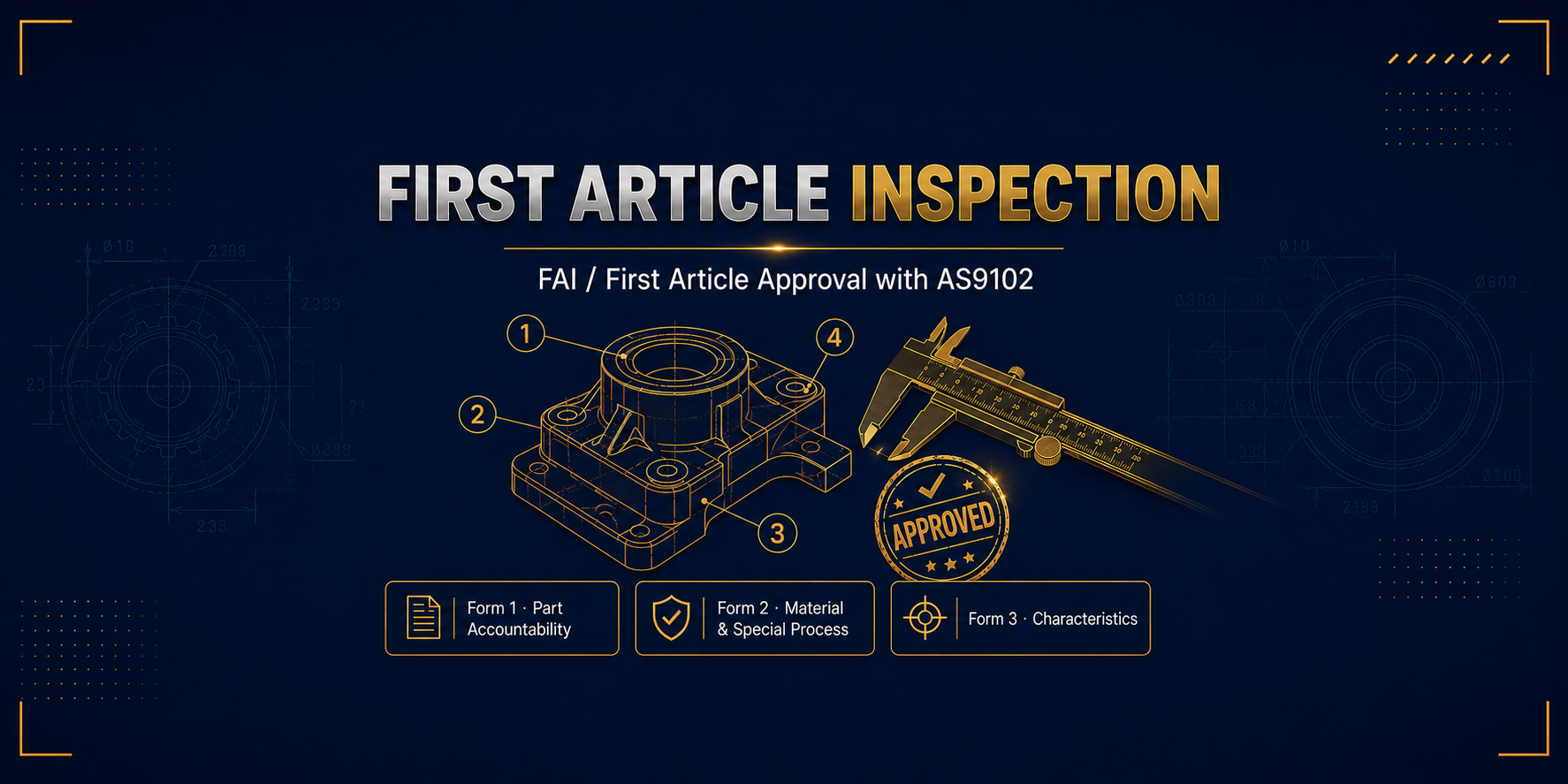
Short answer: First Article Inspection (FAI) is the process of verifying, with objective evidence, that a production process produces parts fully conforming to the design — before serial production begins — for a new or changed part. In aerospace and defense this process is defined by the AS9102 standard and documented with three standard forms (Form 1, 2, 3). The goal is to measure and approve every design characteristic, one by one.
In aerospace and defense manufacturing, a part’s dimensions cannot be “roughly right”; every characteristic must be proven. That is exactly what first article inspection delivers: before serial production starts, it documents that the first produced part meets every feature on the drawing. This guide explains what FAI is, why the AS9100 quality system requires it, the AS9102 forms, and the process step by step.
What Is First Article Inspection (FAI)?
First article inspection is a systematic control activity that verifies — through full measurement of the first parts — that a production process (machine, tooling, operator, material, method) can produce parts meeting the design requirements. FAI is not a single measurement; it is the proof of all design characteristics of the part (dimensions, tolerances, material, coating, special processes, function).
FAI differs from serial quality control: serial control samples, while FAI verifies 100% of characteristics on the first production batch and documents it.
What Is AS9102 and How Does It Relate to FAI?
AS9102 is the international standard defining how first article inspection is performed and documented in the aerospace and defense sector (current version AS9102 Rev C). An AS9100-certified company is expected to run FAI according to AS9102, which documents the process with three standard forms.
When Is FAI Performed? (Triggers)
First article inspection is required when:
- A new part is produced for the first time
- There is a design/drawing revision change — see: configuration management (ECN/ECO)
- The production location, machine or process changes
- The supplier/source changes
- Production has lapsed for more than 2 years
- A customer or nonconformance triggers a special request
What Are the AS9102 Forms?
The AS9102 process consists of three forms. The most detailed of these is Form 3, where every dimension on the drawing is numbered (ballooning) and individually measured and recorded:
| Form | Name | Content |
|---|---|---|
| Form 1 | Part Number Accountability | Part identity, sub-assemblies, references |
| Form 2 | Product Accountability | Raw material, special processes, functional tests |
| Form 3 | Characteristic Accountability | Measurement result of every design characteristic |
How Is First Article Inspection Done Step by Step?
- Ballooning: All characteristics on the drawing are numbered.
- Measurement plan: A method and equipment are defined per characteristic; measurement devices used must be calibrated — see: calibration tracking.
- Production and measurement: The first part is produced and all characteristics measured.
- Special process verification: Certificates for heat treatment, coating, etc. are collected.
- Completing Forms 1-2-3: Results are recorded on the AS9102 forms.
- Nonconformance management: If there is a deviation, the CAPA and nonconformance process is triggered.
- Approval and record: The FAI report is approved and archived in a traceable way.
What Is the Difference Between Full FAI and Partial FAI?
Full FAI verifies all characteristics from scratch (new part). Partial (delta) FAI re-verifies only the characteristics affected by a change (e.g., a single revised dimension). Delta FAI reduces the cost of a full FAI, but scoping it correctly is critical.
What Is the Difference Between FAI and PPAP?
FAI (AS9102) is the first-article approval method used in aerospace-defense, while PPAP is used in automotive. Both answer “does the process produce the right part?”; however, their forms, scope and terminology differ. In an AS9100 environment the expected method is FAI/AS9102.
How Is the FAI Process Managed with ERP?
FAI requires traceable management of many measurements, certificates and forms; running it on scattered files creates audit risk. The HarmonyERP quality management module secures this process:
- Control plans and characteristic-based inspection records
- Calibrated measurement device tracking
- Special process and material certificate management
- Nonconformance and CAPA integration
- New FAI need triggered by configuration when a revision changes
- Single-database traceability with production and inventory
For cross-standard context see ISO 9001 vs AS9100 difference, and for the bigger picture see ERP for the defense industry.
Common Mistakes
- Incomplete ballooning: A skipped characteristic is a nonconformity at audit.
- Measuring with uncalibrated devices: The measurement carries no evidentiary value.
- Skipping FAI after a revision: A change requires a new (at least delta) FAI.
- Not collecting special-process certificates: Form 2 remains incomplete.
Frequently Asked Questions (FAQ)
Is first article inspection mandatory? For aerospace-defense suppliers under AS9100/AS9102, yes; customer contracts also usually require an FAI report.
On how many parts is FAI performed? Usually on the first part that represents the production process; the goal is process verification, not quantity.
What is the current version of AS9102? The current version is AS9102 Rev C, defining the three-form structure (Form 1, 2, 3).
Is the full FAI redone when a revision changes? No; in most cases a partial (delta) FAI for the affected characteristics is sufficient.
What is the advantage of keeping FAI records in ERP? Measurements, certificates and forms become traceable and audit-ready, and a new FAI need surfaces automatically on a revision change.
Conclusion
First article inspection (FAI) is the foundation for confidently moving to serial production in aerospace and defense: through AS9102 forms it proves that every design characteristic is met. The right ERP infrastructure turns FAI from scattered files into a traceable, audit-ready process.
Want to manage your FAI and quality processes with HarmonyERP? Request a free demo or request a quote.
Related Posts
All in Quality Management →What Is UID and MIL-STD-130 Part Marking? Unique Identification and Traceability
Quality ManagementCounterfeit Part Prevention (AS5553) and Electronic Component Traceability
Quality ManagementWhat Is Incoming Quality Control and the Inspection (Control) Plan?
Quality ManagementWhat Are APQP and PPAP? Advanced Product Quality Planning and Part Approval
Transform Your Business with HarmonyERP
Manage manufacturing, accounting, inventory and sales from a single platform. Request a demo and see the difference.