
Defense Contract Management: Contract Line Items, Work Orders and Delivery Tracking
What is defense contract management? Managing CLIN, SOW, WBS, progress payments and delivery with project-based ERP, plus change and cost control.
Defense Contract Management: Contract Line Items, Work Orders and Delivery Tracking
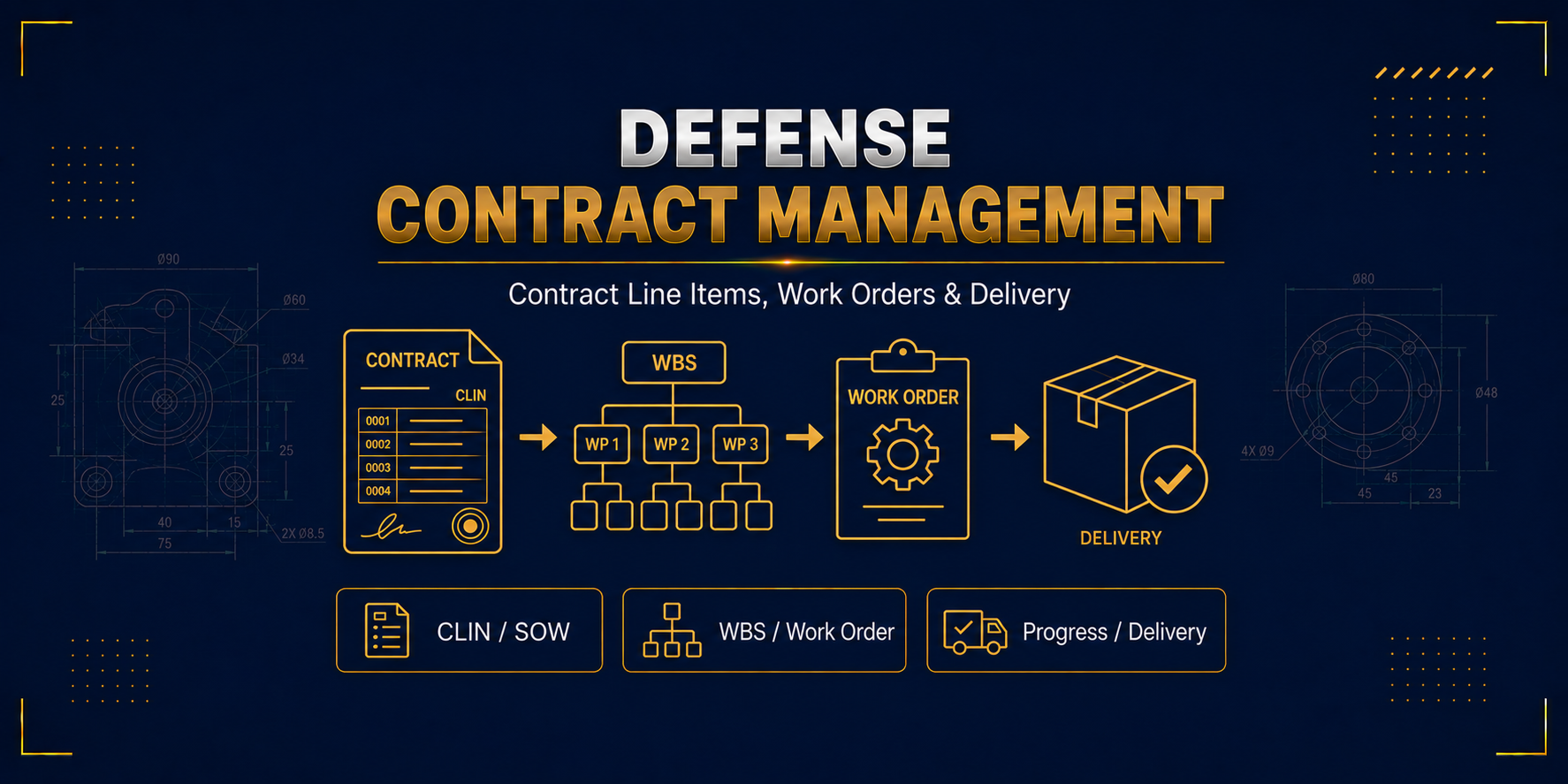
Short answer: Defense contract management is the process of managing long-running, strictly-requirement defense contracts in a single framework — from contract line items (CLIN) to work orders, and from delivery to progress payments. The goal is to keep scope, cost and schedule under control by tying every contract commitment to the work breakdown structure (WBS) and to production. An ERP makes this chain traceable end to end.
Defense contracts last for years and contain many deliverables and changes; a missed line item leads to both penalties and reputational loss. That is exactly what defense contract management prevents: it breaks the contract into work packages, ties it to production, and tracks every delivery and progress payment. This guide covers the core concepts of defense contracts, the flow from contract to delivery, and how an ERP manages the process.
What Is Defense Contract Management?
Defense contract management is the process of holistically managing the entire life cycle of a defense contract — proposal, breakdown into line items, planning, production, delivery, progress payment and closeout. Its difference from classic contract tracking is that every commitment is directly related to project-based manufacturing and project-based cost.
What Are the Core Concepts of Defense Contracts?
| Concept | Description |
|---|---|
| CLIN | Contract Line Item Number |
| SOW | Statement of Work / scope document |
| WBS | Work breakdown structure (splits work into packages) |
| CDRL | Contract Data Requirements List (document deliverables) |
| Milestone | Phased delivery and progress-payment points |
What Are the Contract Pricing Types?
| Type | Description |
|---|---|
| Firm fixed price (FFP) | Price is fixed; risk is on the contractor |
| Cost plus (CPFF/CPIF) | Cost + fee; can vary with performance |
| Hybrid / target cost | A mix of fixed and incentive elements |
The pricing type determines how cost tracking and earned value management (EVM) are set up.
How Does the Flow from Contract to Work Order and Delivery Work?
- Proposal and contract: The proposal is accepted, CLIN and SOW are clarified (CRM/sales).
- Break into WBS: The contract is split into work packages.
- Open work orders: Work packages turn into production work orders.
- Production and progress: Work orders are executed, progress (EV) is measured.
- Delivery and progress payment: When a milestone is completed, delivery is made and a progress payment is issued.
- Invoicing and closeout: The contract line item is completed and closed.
Change (Mod) Management and Scope Control
Change is inevitable in defense contracts. Each change order (contract modification) affects scope, cost and schedule. Managing these changes traceably and in line with configuration management prevents scope creep.
Tracking Progress Payments, Delivery and Invoicing
Every delivery must be tied to a contract line item and a progress payment. By keeping which item was delivered, which progress payment was issued and which amount was invoiced in one place, an ERP prevents losses such as “delivered but not invoiced.”
Defense Contract Management with ERP
Contract management requires sales, project, production and cost to work together. HarmonyERP unifies this chain on one platform:
- Contract → CLIN → WBS → work order linkage
- Delivery and progress payment tracking per milestone
- Project-based cost and budget-vs-actual (project cost)
- Performance monitoring with EVM indicators (EVM)
- Tracking change orders with configuration
Common Mistakes
- Not tying the contract to production: If line items don’t become work orders, deliveries fall out of tracking.
- Managing changes off the record: If cost and schedule impact are invisible, scope creeps.
- Keeping progress payments disconnected from delivery: Uninvoiced deliveries disrupt cash flow.
- Forcing a single pricing logic: FFP and cost-plus require different tracking.
Frequently Asked Questions (FAQ)
What is a CLIN? A Contract Line Item Number; it uniquely defines each deliverable line item in the contract.
Are defense contract management and project management the same? They are intertwined; contract management covers commercial/legal commitments, while project management covers fulfilling those commitments through production.
What is a change order (mod)? An official modification that changes the scope, price or schedule of the contract.
What does ERP provide in contract management? By tying the contract to CLIN, WBS, work order, delivery and progress payment, it provides end-to-end traceability and cost control.
What is the difference between FFP and cost-plus contracts? In FFP the price is fixed and the risk is on the contractor; in cost-plus the cost is reimbursed and a fee is added.
Conclusion
Defense contract management keeps scope, cost and schedule under control by breaking long, complex contracts into line items and tying them to production. The right ERP infrastructure makes the entire chain — from contract to work order to delivery — traceable, reducing the risk of delay and revenue loss.
Want to manage your contract, project and delivery processes with HarmonyERP? Request a free demo or request a quote.
Related Posts
All in Project Management →Transform Your Business with HarmonyERP
Manage manufacturing, accounting, inventory and sales from a single platform. Request a demo and see the difference.