
What Is Project-Based Manufacturing? Milestone & Phased Delivery in Defense Projects
What is project-based manufacturing, and how does it differ from serial production? Milestone management, phased delivery, and ERP-based project tracking in defense projects.
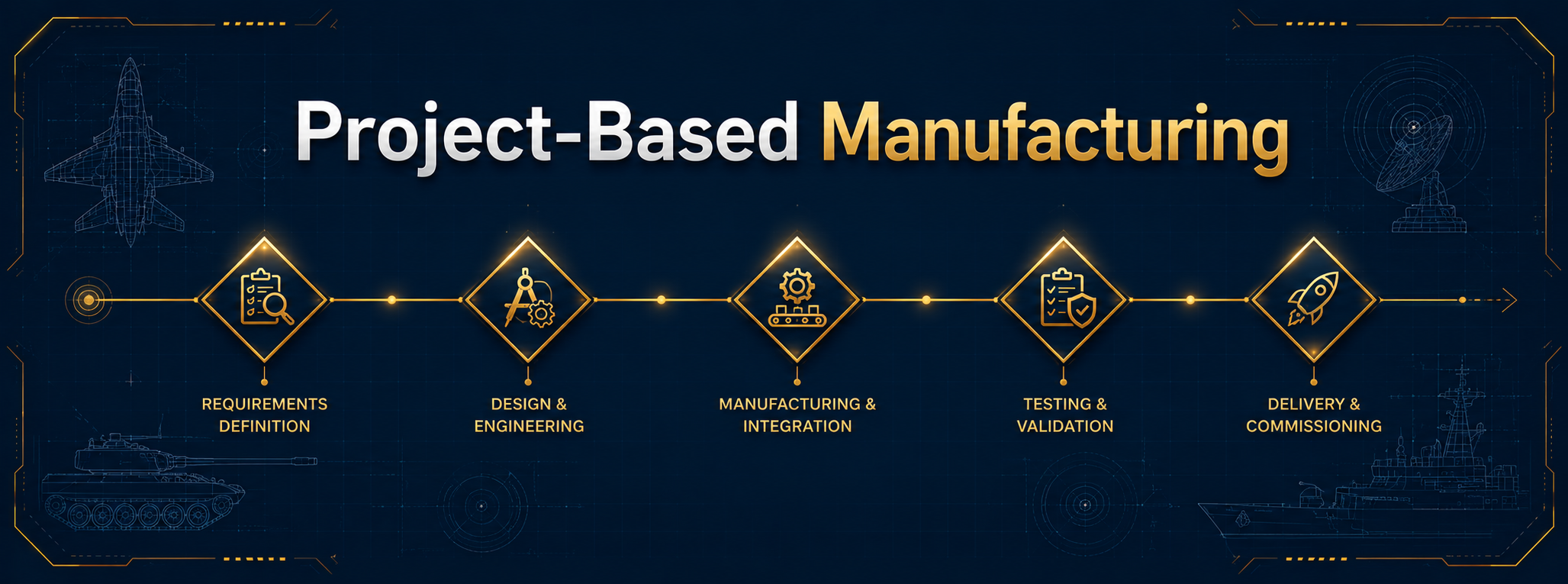
Project-based manufacturing is a production management approach in which each order or contract is planned, budgeted, and tracked as a separate project. Unlike serial production, the products are not repetitive and standard; each project carries its own bill of materials, delivery schedule, milestones, and cost structure. It is the fundamental production model in long-running, high-value work such as defense, aerospace, shipbuilding, and large machinery manufacturing.
Defense projects can span years or even decades; phased deliveries, milestone-based payment plans, and project-based budget control determine the financial and operational health of this long-running work. This guide explains what project-based manufacturing is, how milestone and phased delivery management work in defense projects, and how this process is managed with an ERP, step by step.
What Is Project-Based Manufacturing?
Project-based manufacturing is a production model in which each customer order or contract is treated as a unique project. In this model, production is carried out against a specific contract rather than for stock; each project has its own technical requirements, delivery stages, and cost targets. In the defense industry, the production of a radar system, a UAV subsystem, or an armored vehicle component is a typical example of project-based manufacturing.
This approach differs from serial production in three key respects:
- Repeatability: Serial production makes the same product in large quantities; in project-based manufacturing, every job is unique.
- Planning unit: Serial production is planned by product/batch; project-based manufacturing is planned by project and milestone.
- Cost tracking: In serial production, unit cost matters; in project-based manufacturing, the project’s overall budget-versus-actual balance matters.
What Is the Difference Between Project-Based and Serial Manufacturing?
The two models operate on different logic, from planning to costing. The table below summarizes the key differences:
| Criterion | Serial Production | Project-Based Manufacturing |
|---|---|---|
| Production trigger | Stock / demand forecast | Contract / order |
| Product structure | Standard, repetitive | Unique, project-specific |
| Planning unit | Batch / product | Project / milestone |
| Delivery | Continuous flow | Phased, milestone-based |
| Cost focus | Unit cost | Project budget vs. actual |
| Payment | Order-based | Milestone-based progress billing |
What Is Milestone Management in Defense Projects?
A milestone is a control point at which a measurable, deliverable stage of a project is completed. In defense projects, milestones are usually contract-bound: stages such as design reviews (PDR/CDR), first article inspection, prototype delivery, serial production approval, and final delivery are each defined as a milestone. Each milestone represents both a technical advance and, in most cases, a payment entitlement.
Effective milestone management includes the following elements:
- Milestone definition: The scope, deliverables, and acceptance criteria of each stage are clearly defined.
- Schedule linking: Milestones are tied to the project schedule and the critical path.
- Progress tracking: The completion percentage of each milestone is monitored with real production data.
- Progress billing and payment: Completed milestones are linked to the milestone-based payment plan to manage cash flow.
How Do Phased Delivery and Progress Billing Work?
Phased delivery is the contractually compliant delivery of specific portions of a project before the whole is finished. In defense projects, this is the primary way to manage both risk and cash flow. Each phased delivery corresponds to a milestone and usually to a payment entitlement; this way, the manufacturer is compensated for progress without waiting for the entire project to complete.
Summary: The most critical balance in project-based manufacturing is keeping technical progress and financial progress in sync. When a milestone is technically completed, the related billing and payment process should also be triggered. When this synchronization is managed with spreadsheets, the link between progress and cost easily breaks, and projects slip into budget overruns.
How Is Project-Based Manufacturing Managed with ERP?
The complexity of project-based manufacturing — unique bills of materials, milestone dependencies, phased deliveries, and project-based cost — is highly error-prone when managed without an ERP system. A defense industry ERP makes each project manageable end to end on a single platform.
HarmonyERP supports project-based manufacturing with the real capabilities defined on its defense solution:
- Project card: Open each defense project with a separate project card, gathering all of the project’s production, cost, and delivery data in one place.
- Milestone management and phased delivery: Define milestones, track phased delivery, and keep every stage of the project under control.
- MPS and MRP engines: The Master Production Schedule (MPS) and Material Requirements Planning (MRP) engines automatically generate production orders and purchase requests from project needs.
- Advanced scheduling and critical path: Perform critical path analysis with advanced scheduling to stay faithful to project timelines and foresee delay risks.
- Resource planning: Plan machine, labor, and material resources at the project level to prevent bottlenecks.
These capabilities work in integration with the cost side of the project as well: the actual cost of each project is tracked by raw material, labor, subcontracting, and overhead; cash flow is managed with milestone-based payment plans. This keeps technical progress and financial progress synchronized in a single system.
Common Mistakes in Project-Based Manufacturing
- Treating milestones only as dates. A milestone is a technical deliverable; not just a date but also acceptance criteria and a payment entitlement must be defined.
- Keeping progress and cost separate. If technical progress and financial actuals are tracked in separate systems, a budget overrun grows unnoticed.
- Neglecting the project-based bill of materials. Since every project is unique, production orders come out wrong without an accurate, revision-controlled BOM.
- Planning long-lead parts too late. If the lead time of critical components is not planned up front with MRP, a single part can shift the entire milestone schedule.
- Failing to see resource conflicts. When the same machine or team overlaps across multiple projects, delays are inevitable without critical path analysis.
Frequently Asked Questions
What is a defense industry ERP?
A defense industry ERP is enterprise resource planning software developed for aerospace and defense manufacturers that require project-based manufacturing, compliance with strict quality standards such as AS9100 and ISO 9001, lot/serial-level end-to-end traceability, and project-based costing. It unifies production, quality, procurement, and cost processes on a single secure platform. HarmonyERP meets these needs with project cards, milestone management, and an on-premise architecture.
What is the difference between project-based and serial manufacturing?
Serial production makes standard products repetitively based on stock or demand forecasts. In project-based manufacturing, each job is carried out against a unique contract; planning proceeds by project and milestone, delivery is phased, and cost is tracked through the project’s overall budget-versus-actual balance.
Why is milestone management important in defense projects?
Defense projects are long-running and high-value; payments are usually tied to milestone-based progress billing. Milestone management links technical progress to measurable control points and clarifies both the deliverable and the payment entitlement of each stage. This keeps the project under control both on schedule and financially.
What do MPS and MRP do in project-based manufacturing?
MPS (Master Production Schedule) turns project needs into a production schedule; MRP (Material Requirements Planning) then calculates which material is needed when, generating automatic purchase requests and production orders. These two engines are critical for ensuring long-lead parts are procured on time.
How does HarmonyERP manage project-based manufacturing?
HarmonyERP opens each defense project with a separate project card and runs milestone management, phased delivery tracking, and resource planning on a single platform. MPS and MRP engines generate automatic production and purchase requests from project needs, and critical path analysis is performed with advanced scheduling. With project-based cost accounting, budget versus actual is tracked in real time.
Conclusion
Project-based manufacturing is a production model in which each contract is planned as a unique project, advances through milestones, and is managed with phased deliveries; it is the fundamental way of working in the defense industry. The success of this model depends on keeping technical progress and financial actuals in sync. Unique bills of materials, milestone dependencies, and long-lead parts increase the risk of budget overruns and delays when managed manually; an ERP system keeps these processes synchronized with real production data.
HarmonyERP’s manufacturing management module manages your defense projects end to end with project cards, milestone management, MPS/MRP, and advanced scheduling. With 20+ years of enterprise software experience, we help aerospace and defense manufacturers set up their project processes in an audit-ready and delivery-ready way. To see our defense-specific solution live, request a free demo.
Related guides: Defense Industry ERP Solution · Manufacturing Management Module
Related Posts
All in Manufacturing Management →What is a Bill of Materials (BOM)? Why It's the Most Critical Document in Manufacturing
Manufacturing ManagementProduction Planning: The Foundation of Agile and Efficient Manufacturing
Manufacturing ManagementWhat is a Manufacturing Execution System (MES)?
Manufacturing ManagementWhat is Lean Production and How is it Applied?
Transform Your Business with HarmonyERP
Manage manufacturing, accounting, inventory and sales from a single platform. Request a demo and see the difference.