
What is a Bill of Materials (BOM)? Why It's the Most Critical Document in Manufacturing
A Bill of Materials (BOM) is the structured list of every raw material, sub-assembly, intermediate and component needed to manufacture a finished product. This guide explains BOM types, structure, common mistakes and best practices.
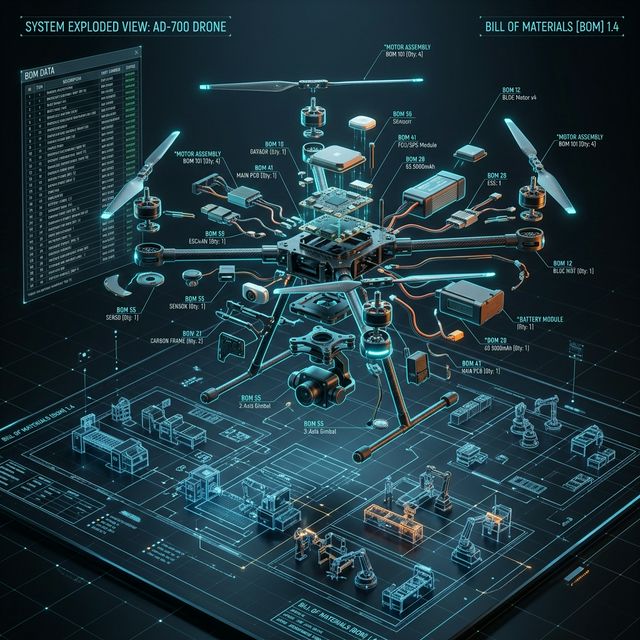
The DNA of Flawless Production: What is a Bill of Materials (BOM)?
Imagine you want to bake a cake at home. Without a recipe telling you how much flour, how many eggs and how much sugar to use, turning on the oven is pointless. In industrial manufacturing, the exact equivalent of this “recipe” is the Bill of Materials, universally abbreviated as BOM. From producing a bicycle to assembling a multi-thousand-millimeter aircraft, no engineering, purchasing or assembly operation can be launched without a solid BOM.
A Bill of Materials is the structured, hierarchical list of every raw material, intermediate, sub-assembly and component needed to produce a finished product, along with the quantity, unit of measure and (often) supplier information for each item. It is the single source of truth that connects engineering, procurement, production and finance — and a wrong BOM ripples through every one of those functions.
Why the BOM is the Most Critical Manufacturing Document
The BOM is not just an internal list — it is the backbone of the entire production cycle:
- Procurement uses the BOM to plan purchases, run MRP (Material Requirements Planning), and trigger supplier orders.
- Production uses the BOM to issue materials to the line, schedule work orders, and track consumption.
- Costing uses the BOM (multiplied by routing labor) to calculate standard cost and margin.
- Quality uses the BOM to identify exactly which components went into which finished lot — critical for recall and traceability.
- Engineering change management uses the BOM as the version-controlled record of what each product revision contains.
If the BOM is wrong, every downstream calculation is wrong: wrong purchases, wrong cost, wrong production plan, wrong margins.
Single-Level vs Multi-Level BOM
Single-Level BOM
A single-level BOM lists only the direct components of the finished product, with no further decomposition. A simple stationery item like a binder might have a single-level BOM of “cover, rings, label”. This format is fast to create and read but hides complexity in items that have their own sub-structures.
Multi-Level BOM
A multi-level BOM expands every sub-assembly into its own components, creating a tree structure that can have 5–10 levels for complex products like cars, aircraft or electronics. Each branch shows parent-child relationships, lead times and quantities. Multi-level BOMs are essential for accurate MRP and full traceability but require more discipline to maintain.
Engineering BOM vs Manufacturing BOM
Two BOMs often coexist for the same product:
- Engineering BOM (eBOM): the design view — what engineering specified the product should contain. Organized by function or design grouping.
- Manufacturing BOM (mBOM): the production view — same product, but reorganized by how it is actually built on the shop floor, including consumables, tooling fixtures, packaging and sub-assembly sequences.
Mature manufacturers maintain both and synchronize them through PLM (Product Lifecycle Management) or ERP. Treating eBOM and mBOM as one document is a common source of friction between engineering and production.
What a Good BOM Contains
A well-structured BOM line includes at minimum:
- Item code (part number) and revision
- Description
- Quantity per parent
- Unit of measure
- Make/buy flag
- Lead time
- Default supplier (for buy items)
- Phantom flag (yes/no — for sub-assemblies not physically stocked)
- Effective and obsolete dates
- Reference designator (for electronics, position on PCB)
Adding alternate items (substitutes) and yield/scrap factors makes the BOM much more useful for real-world production where consumption rarely matches theoretical demand exactly.
Common BOM Mistakes That Hurt Production
- Inconsistent units of measure — kg vs g, m vs mm — causing MRP to order 1000× too much or too little.
- Missing scrap factors — assuming 100% yield when reality is 95%, leading to chronic material shortages.
- Outdated revisions — production builds against an old BOM after engineering released a new one.
- No phantom items — every intermediate is stocked, bloating inventory with parts nobody intended to keep.
- Wrong make/buy flags — buying a part the plant could make in-house, or trying to manufacture an item only the supplier can produce.
BOM Management Best Practices
- Single source of truth: keep the BOM in ERP/PLM, not in spreadsheets that drift out of sync.
- Version control: every change should be reviewed, approved and traceable to the engineering change order (ECO) that triggered it.
- Cross-functional review: engineering, production, procurement and quality all need to sign off before a BOM goes live.
- Periodic audit: at least annually, sample 5–10% of BOMs against actual line consumption to catch drift.
- Lifecycle gates: phase-in / phase-out flags so the BOM knows when to start using a new component and stop using the old.
Frequently Asked Questions
What is the difference between BOM and recipe?
The terms overlap. “Recipe” is more common in process manufacturing (food, chemicals, pharmaceuticals) and includes processing conditions. “BOM” is more common in discrete manufacturing (automotive, electronics, machinery) and focuses on the structured component list. ERP systems often support both as variants of the same data model.
How often should a BOM be updated?
Whenever an engineering change is approved, a new supplier component is qualified, or a yield factor changes meaningfully. In stable mature products, this might be monthly; in fast-iterating new products, it can be weekly.
Can a BOM have multiple levels of depth?
Yes. Complex products like vehicles or aircraft routinely have BOMs 8–12 levels deep. ERP systems handle the recursion automatically when calculating MRP, total cost and traceability.
What is a phantom BOM?
A phantom (or “transient”) BOM represents a sub-assembly that is structurally meaningful but never physically held in stock — it is built and immediately consumed by the next operation. Marking it phantom keeps the BOM accurate without inflating inventory transactions.
Does every manufacturer need a formal BOM?
If the product has more than 3–4 components, yes. Even small contract manufacturers benefit from a formal BOM — it is the foundation of accurate quoting, repeatable production and meaningful margin analysis.
Conclusion
The Bill of Materials is the document that ties every manufacturing function together: engineering, purchasing, production, costing and quality all depend on it. A clean, version-controlled, multi-level BOM in ERP is one of the highest-leverage investments a manufacturer can make — it eliminates entire categories of error, accelerates new product introduction, and makes data-driven decisions possible. A messy BOM, by contrast, silently undermines every other improvement initiative. If you have to fix one thing in your manufacturing data, fix the BOM first.
Related Posts
All in Manufacturing Management →What Is Project-Based Manufacturing? Milestone & Phased Delivery in Defense Projects
Manufacturing ManagementProduction Planning: The Foundation of Agile and Efficient Manufacturing
Manufacturing ManagementWhat is a Manufacturing Execution System (MES)?
Manufacturing ManagementWhat is Lean Production and How is it Applied?
Transform Your Business with HarmonyERP
Manage manufacturing, accounting, inventory and sales from a single platform. Request a demo and see the difference.