
What Is Earned Value Management (EVM)? Performance Measurement in Defense Projects
What is earned value management (EVM) and how is it calculated? PV, EV, AC with CPI/SPI, EAC forecasting, and budget-performance tracking in defense projects with ERP.
What Is Earned Value Management (EVM)? Performance Measurement in Defense Projects
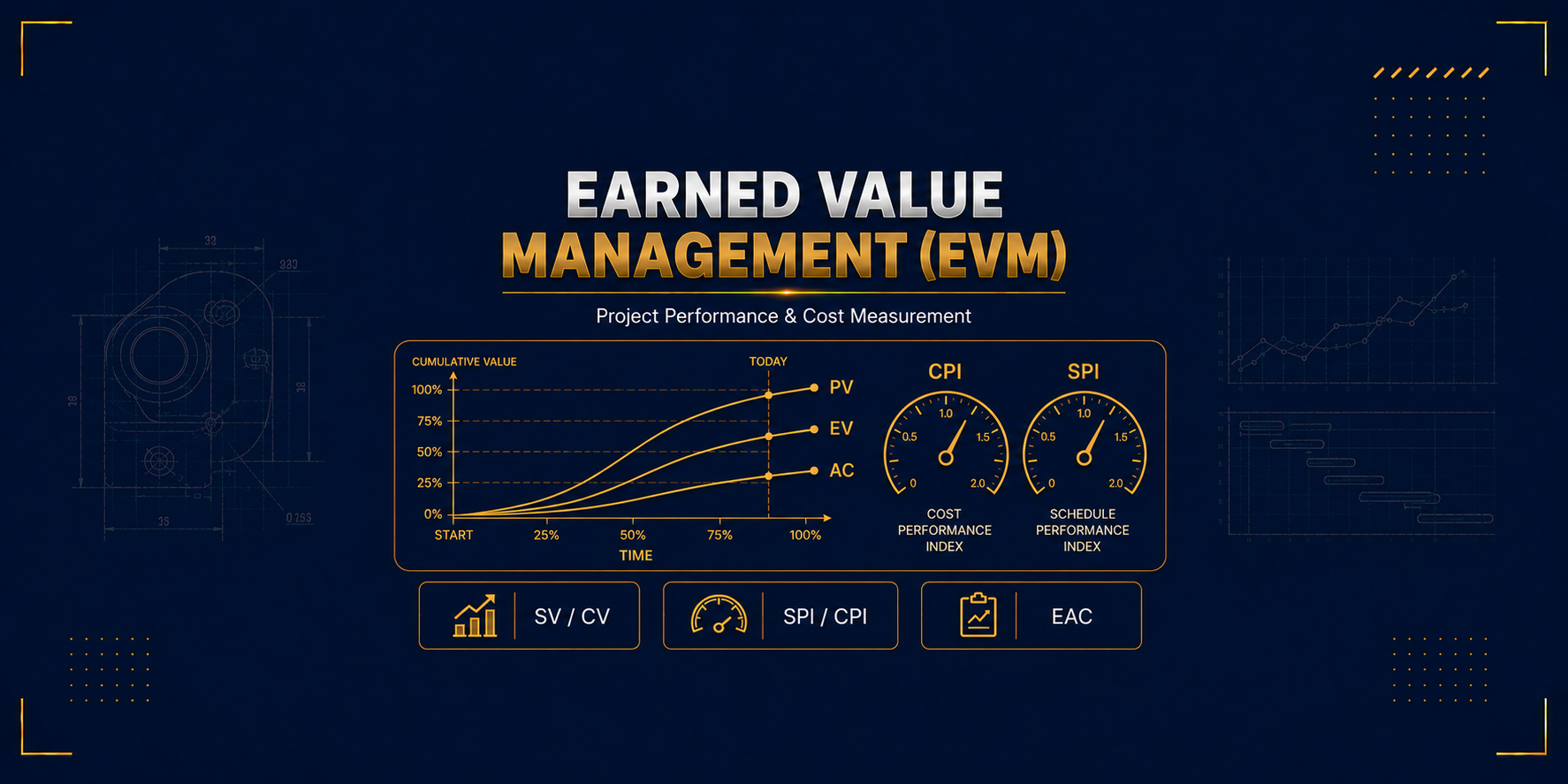
Short answer: Earned Value Management (EVM) is a method that measures a project’s cost and schedule performance with objective numbers. It uses three core values: PV (planned value), EV (earned value — the budgeted value of work actually completed) and AC (actual cost). From these three, the CPI and SPI indices are calculated — so the question “is the project on budget and on schedule?” is answered with data, not guesswork.
In long-running defense projects, saying “60% of the work is done” is not enough; where that progress stands against budget and schedule must be measured. That is exactly what earned value management (EVM) provides: it measures not the money spent, but the value produced for that money. This guide covers EVM’s core metrics, how it is calculated, the ANSI/EIA-748 requirement in defense, and how an ERP automates this measurement.
What Is Earned Value Management (EVM)?
EVM is a management technique that combines a project’s scope, schedule and cost in a single framework to measure performance. Classic tracking asks “how much did we spend?”; EVM asks “how much work did we complete for the money we spent?” This approach is the advanced level of project-based cost accounting and is directly related to project-based manufacturing.
EVM’s Three Core Metrics: PV, EV, AC
| Metric | Name | Meaning |
|---|---|---|
| PV | Planned Value | Budgeted value of work planned to date |
| EV | Earned Value | Budgeted value of work actually completed |
| AC | Actual Cost | Amount actually spent |
These three values form the basis of all the project’s performance indicators. The total budget is called BAC (Budget at Completion).
How Is EVM Calculated?
The core indicators and their formulas:
| Indicator | Formula | Interpretation |
|---|---|---|
| SV (Schedule Variance) | EV − PV | Negative means behind schedule |
| CV (Cost Variance) | EV − AC | Negative means over budget |
| SPI (Schedule Performance Index) | EV / PV | <1 means slow |
| CPI (Cost Performance Index) | EV / AC | <1 means expensive |
Example: Total budget (BAC) is 1,000,000. Work planned to date is 50% (PV = 500,000), work actually completed is 40% (EV = 400,000), and the amount spent is 450,000 (AC).
- SV = 400,000 − 500,000 = −100,000 (behind schedule)
- CV = 400,000 − 450,000 = −50,000 (over budget)
- SPI = 400,000 / 500,000 = 0.80
- CPI = 400,000 / 450,000 = 0.89
How Is Completion Estimated with EAC?
EVM forecasts not only the present but also the future. EAC (Estimate at Completion) shows how much the project will cost if current performance continues:
EAC = BAC / CPI → 1,000,000 / 0.89 ≈ 1,125,000
In other words, at the current pace the project will exceed the budget by about 12.5%. This forecast enables corrective action to be taken.
How Are SPI and CPI Interpreted?
| Value | Meaning |
|---|---|
| = 1.00 | Exactly on plan |
| > 1.00 | Ahead of budget/schedule (good) |
| < 1.00 | Over budget / delayed (caution) |
EVM and ANSI/EIA-748 in Defense Projects
In large defense contracts EVM is often mandatory and requires an Earned Value Management System (EVMS) defined by the ANSI/EIA-748 standard. This system combines the work breakdown structure (WBS), budgeting, measurement and reporting in a disciplined framework; it is the foundation of budget-vs-actual transparency in defense.
Managing EVM with ERP
EVM requires work-breakdown, budget, progress and cost data to be in one place and in real time. Collecting this data by hand is slow and error-prone. HarmonyERP feeds EVM automatically from project data:
- Project-based budget and actuals (project-based cost)
- Progress (EV) measurement per work package/milestone (production)
- Collecting PV, EV, AC data in a single database
- Reporting CPI/SPI and EAC indicators
- Actual-cost integration with accounting
Common Mistakes
- Setting EV subjectively: Progress must be measured by defined rules, not by “feel.”
- Confusing AC with EV: Spending is not the value of completed work.
- Looking only at cost: CPI can be good while SPI is bad; both must be assessed together.
- Not updating EAC: The forecast must be refreshed as performance changes.
Frequently Asked Questions (FAQ)
What is EVM used for? It objectively measures a project’s cost and schedule performance and forecasts the cost at completion.
What are CPI and SPI? CPI is cost performance (EV/AC), SPI is schedule performance (EV/PV); below 1 is a warning sign.
How is EAC calculated? The most common method is EAC = BAC / CPI; it gives the estimated total cost if current performance continues.
Is EVM mandatory in defense? In large contracts an ANSI/EIA-748-compliant EVMS is usually mandatory.
How does ERP help with EVM? By collecting budget, progress and cost data in one system, it calculates CPI/SPI and EAC automatically and in real time.
Conclusion
Earned value management turns performance in defense projects from guesswork into data: with PV, EV and AC, whether the project is on budget and on schedule is seen clearly, and the cost at completion is forecast in advance. The right ERP infrastructure produces this measurement automatically from project data, providing early warning.
Want to manage your project performance and cost tracking with HarmonyERP? Request a free demo or request a quote.
Related Posts
All in Project Management →Transform Your Business with HarmonyERP
Manage manufacturing, accounting, inventory and sales from a single platform. Request a demo and see the difference.