
Project-Based Cost Accounting: Budget vs. Actual Tracking in Defense Projects
How is project-based cost accounting and project cost tracking done? Budget-vs-actual analysis, raw material/labor/subcontracting breakdown, and milestone payment plans in defense projects.
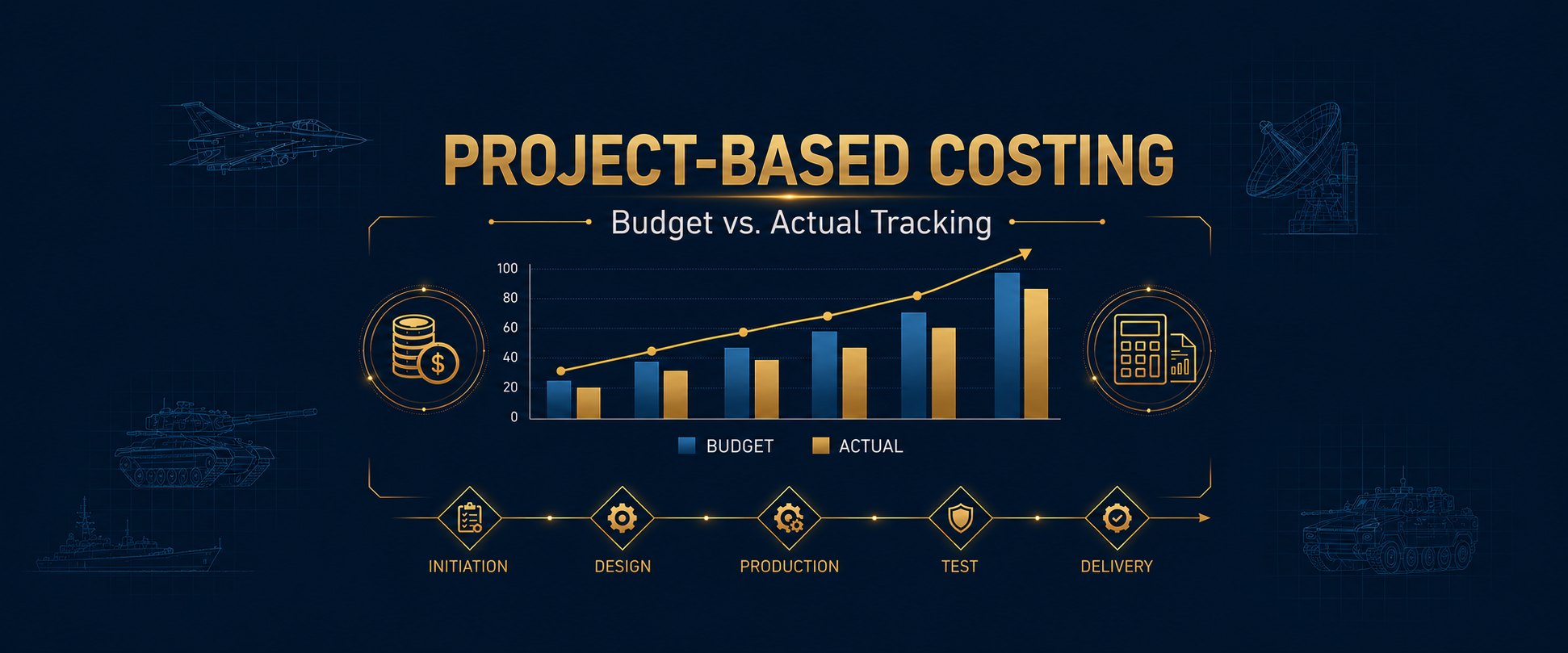
Project-based cost accounting is an accounting approach in which the revenues and expenses of each project are tracked separately and the budgeted cost is continuously compared against the actual cost incurred. Unlike standard cost accounting, the focus is not the unit cost of a product but the project’s overall budget-versus-actual balance. Raw material, labor, subcontracting, and overhead are broken down by project; on the revenue side, milestone-based payment plans are tracked. It is the fundamental method that determines the financial health of long-running projects such as defense, aerospace, and shipbuilding.
In a defense project spanning years, being unable to see where, when, and why cost exceeds the budget silently erodes the project’s profitability. This guide explains what project cost tracking is, how budget-versus-actual analysis is performed, how the raw material/labor/subcontracting breakdown and milestone-based payment plans are managed, and how this process is controlled with an ERP.
What Is Project-Based Cost Accounting?
Project-based cost accounting is an accounting method that treats each project as a separate cost center and tracks all expenses and revenues belonging to that project under a single roof. Its purpose is to answer the question “is this project progressing within the budget we planned?” clearly at any moment.
In standard (serial) production accounting, the focus is unit cost; because the same product is produced in large quantities, the cost per unit matters. In project-based manufacturing, each job is unique; therefore, cost is tracked through the individual project’s total budget and actuals. This approach is the natural financial complement to the project-based manufacturing model.
What Components Make Up Project Cost?
The actual cost of a defense project is formed by the breakdown of four main items. Tracking each item separately makes it possible to see where a budget deviation originates:
- Raw material and supplies: Project-specific raw material, component, and consumable expenses.
- Labor: The time and cost of personnel working directly on the project (direct labor).
- Subcontracting and outsourced services: Operations outsourced, subcontractor, and external service costs.
- Manufacturing overhead: Shared expenses allocated to the project, such as energy, depreciation, and indirect labor.
When these four items are not tracked separately, it cannot be seen why the project exceeds the budget; the total figure is known, but the root cause remains hidden.
How Is Budget vs. Actual Analysis Performed?
Budget-versus-actual analysis is the comparison of the cost planned at the start of the project with the cost actually incurred during the process. An effective analysis proceeds through the following steps:
- Define the project budget: An initial budget is set for the raw material, labor, subcontracting, and overhead items.
- Collect actual cost: As production progresses, the real expenses for each item are recorded on the project card.
- Calculate variance: The difference (variance) between budget and actual is calculated for each item.
- Root cause analysis: The source of the deviation (price increase, excess consumption, subcontractor delay, etc.) is identified.
- Action and revision: The budget is revised or corrective action is taken if necessary.
Summary: The value of budget-versus-actual analysis is being able to see the deviation while the process is still ongoing, not after the project is finished. A cost deviation detected early can be managed; a deviation noticed at the end of the project can only be recorded. This is why tracking actual cost in real time and by line item is critical.
How Are Milestone-Based Payment Plans Managed?
In defense projects, revenue is often received not in a single payment but through progress billings tied to milestones. When a specific stage is completed (for example, design approval, prototype delivery, or batch shipment), the payment installment defined in the contract is earned. This structure balances both the manufacturer’s cash flow and the customer’s risk management.
For effective management of a milestone-based payment plan:
- Each milestone is tied to its technical deliverable and the payment installment in the contract.
- When a milestone is completed, the related progress billing is triggered automatically.
- Cash flow is tracked together with incoming billings and ongoing project expenses.
This way, technical progress (milestone completion) and financial progress (billing and collection) run in sync; the project stays under control both on schedule and financially.
How Is Project-Based Cost Accounting Managed with ERP?
Tracking project cost with spreadsheets quickly gets out of control in long-running, multi-item defense projects: actual expenses are recorded late, the budget-versus-actual gap is seen late, and milestone billings become disconnected from production data. A defense industry ERP makes cost accounting real-time by tying it to production and procurement data.
HarmonyERP’s accounting and finance module supports project-based cost accounting with the following capabilities:
- Project-based cost accounting: Track each project as a separate cost center; collect raw material, labor, subcontracting, and overhead by line item.
- Budget vs. actual tracking: Compare the planned budget with the actual cost and see deviations instantly with realization and deviation reports.
- Actual and standard costing: Calculate actual cost from real production data with work order-based cost analysis and compare it with standard cost.
- Milestone-based payment plans: Tie progress billings to milestones and manage cash flow in sync with project progress.
Because these capabilities work in integration with the production, procurement, and inventory modules, cost becomes not a separate accounting record but a real-time reflection of production.
Common Mistakes in Project Cost Tracking
- Totaling cost at the end of the project. If actual expenses are not recorded throughout the process, the budget deviation is only seen when the job is done and cannot be managed.
- Not breaking down by line item. The total cost is known, but without a raw material/labor/subcontracting breakdown, the root cause of the deviation cannot be found.
- Not allocating overhead. If indirect expenses are not allocated to projects, the real project profitability is calculated incorrectly.
- Keeping technical progress and financial progress separate. If milestone completion is not tied to progress billing, cash flow becomes unpredictable.
- Never revising the budget. If the budget is not updated when the scope changes, measurement is made against an unrealistic target.
Frequently Asked Questions
What is a defense industry ERP?
A defense industry ERP is enterprise resource planning software developed for aerospace and defense manufacturers that require project-based cost accounting and budget-versus-actual tracking, compliance with strict quality standards such as AS9100 and ISO 9001, serial/lot-level traceability, and project-based manufacturing. It unifies production, cost, quality, and procurement processes on a single secure platform. HarmonyERP meets these needs with project-based cost accounting and milestone-based payment plans.
What is the difference between project-based cost accounting and standard cost accounting?
Standard cost accounting focuses on the unit cost of the same product produced in large quantities. Project-based cost accounting treats each unique project as a separate cost center and shifts the focus to the project’s overall budget-versus-actual balance. In long-running, individual projects such as defense, the project-based approach is necessary.
What is budget vs. actual analysis?
Budget-versus-actual analysis is the comparison of the cost planned at the start of the project with the cost actually incurred during the process. For each cost item, the deviation (variance) between budget and actual is calculated, the root cause of the deviation is identified, and corrective action is taken if necessary. The goal is to see and manage the cost deviation before the project ends.
What is a milestone-based payment plan?
A milestone-based payment plan means that project revenue is received not in a single payment but through progress billings tied to the completion of specific stages (milestones). For example, when design approval, prototype delivery, or batch shipment is completed, the payment installment defined in the contract is earned. This structure balances the manufacturer’s cash flow with project progress.
How does HarmonyERP track project cost?
HarmonyERP tracks each project as a separate cost center and collects raw material, labor, subcontracting, and overhead by line item. It shows deviations instantly by comparing the planned budget with the actual cost and calculates actual cost from real production data. With milestone-based payment plans, it ties progress billings to project progress and keeps cash flow in sync.
Conclusion
Project-based cost accounting is a method that treats each project as a separate cost center, continuously compares budget with actuals, and protects the financial health of long-running projects such as defense. Breaking down raw material, labor, subcontracting, and overhead by line item makes it possible to see the root cause of a deviation; milestone-based payment plans keep technical progress and financial progress in sync. Doing this tracking manually makes control impossible in long projects; an ERP system ties cost to production data in real time.
HarmonyERP’s accounting and finance module runs project-based cost accounting with budget-versus-actual tracking, actual costing, and milestone-based payment plans. With 20+ years of enterprise software experience, we help aerospace and defense manufacturers manage their project costs in a real-time and audit-ready way. To see our defense-specific solution live, request a free demo.
Related guides: Defense Industry ERP Solution · Accounting & Finance Module · What Is Project-Based Manufacturing?
Related Posts
All in Accounting & Finance →What is Cumulative Transaction Amount and Why Does It Matter?
Accounting & FinanceWhat Is a Balance Sheet? Understanding the Financial Snapshot of Your Business
Accounting & FinanceHow to Write a Check Correctly: A Step-by-Step Guide for Businesses
Accounting & FinanceWhat Is a Letter of Guarantee? A Key Tool in Corporate Risk Management
Transform Your Business with HarmonyERP
Manage manufacturing, accounting, inventory and sales from a single platform. Request a demo and see the difference.