
What Is Localization Rate and Indigenization? Local Content Tracking in Defense
What are the localization rate and indigenization, and how are they calculated? Local content, the local-goods certificate, tender importance, and local/import cost tracking with ERP.
What Is Localization Rate and Indigenization? Local Content Tracking in Defense
Short answer: The localization rate is the percentage of local contribution (local inputs, labor and overhead) within the total cost of a product or system. Indigenization is the process of turning a foreign-sourced part, product or technology into one produced locally. In Türkiye’s defense tenders, the localization rate is an important preference and evaluation criterion that must be calculated and documented correctly.
In Türkiye’s defense industry, “how local are we?” is no longer a slogan but a criterion that is measured and scored in tenders. That is exactly what the localization rate and indigenization make concrete: they calculate how much of a product is produced with local contribution and aim to convert import-dependent parts into local production. This guide covers what the localization rate is, how it is calculated, its importance in defense tenders, and how an ERP eases this tracking.
What Is the Localization Rate?
The localization rate is the ratio showing the share of local contribution within a product’s total cost. Local contribution consists of domestically sourced materials and services, local labor and local overhead. Import inputs are excluded from this calculation. A high localization rate indicates low external dependency and high contribution to the local supply chain.
What Is Indigenization? How Does It Differ from Localization?
Indigenization is the process of designing and producing a previously imported part, material or technology locally. The localization rate is a measure (it shows the current state); indigenization is a process (it aims to increase localization). Together, they also serve the ultimate goal of programs such as offset/industrial participation and EYDEP.
How Is the Localization Rate Calculated?
The basic formula:
Localization Rate (%) = (Local Contribution Amount / Total Cost) × 100
Local contribution = local inputs + local labor + local overhead (excluding import inputs).
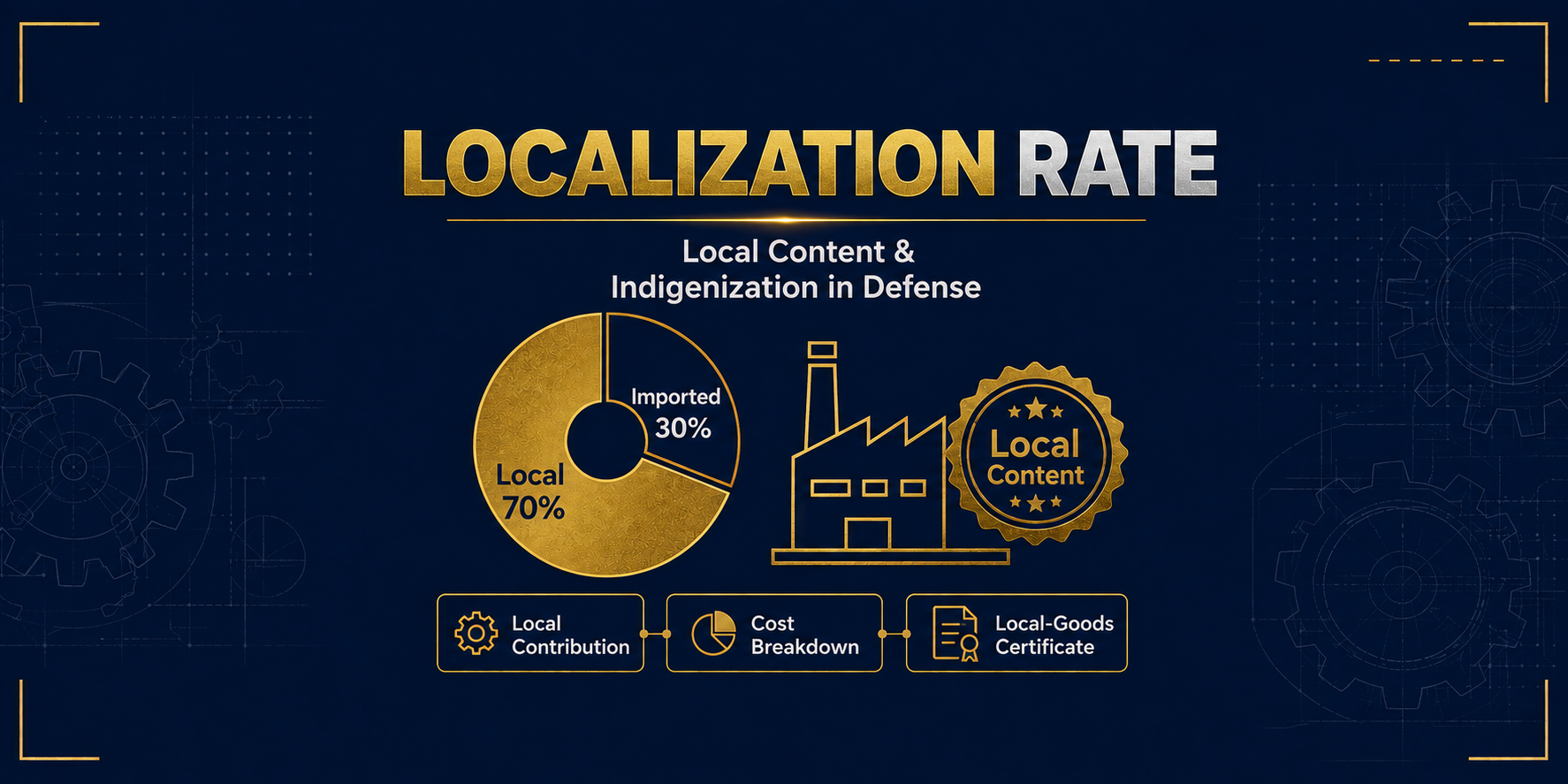
Example: A product’s total cost is 100 units. If 30 units are import inputs and 70 units are local contribution (local material + labor + overhead):
- Localization Rate = (70 / 100) × 100 = 70%
For an accurate calculation, the local/import split of each input and the cost breakdown must be clear.
What Are the Local-Goods Certificate and Local Contribution Rate?
The local-goods certificate is the official document showing that a product meets the defined localization criteria (chamber-approved). In tenders, firms offering local goods may be granted a price advantage. The local contribution rate expresses the product’s local-contribution percentage and forms the basis of the certificate.
Why Is Localization Important in Defense Tenders?
- Evaluation criterion: The localization rate affects scoring in defense tenders.
- Price advantage: Offers with a local-goods certificate can gain an advantage.
- Strategic independence: Reduces external dependency for critical parts.
- Sustainable supply: A local supply chain lowers supply risk.
What Are the Challenges in Tracking the Localization Rate?
- Correctly making the local/import split of each input
- Keeping the cost breakdown (material, labor, overhead) clear
- Keeping the rate current with exchange-rate and price changes
- Documenting for many parts and suppliers
Local Contribution and Localization Rate Tracking with ERP
The localization rate is based directly on procurement and cost data; if this data is not current and separated, the rate becomes unreliable. HarmonyERP provides the data the localization calculation needs:
- Recording inputs with a local/import split (procurement and inventory)
- Cost breakdown by material, labor and overhead (production costing)
- Traceability with supplier and origin information
- Integrated reporting to track the local contribution rate from this data
Note: ERP does not issue the local-goods certificate; it makes the cost and origin data required for certification and declaration organized and verifiable.
Common Mistakes
- Not making the local/import split: The rate cannot be calculated with unseparated data.
- Keeping the cost breakdown incomplete: If labor and overhead are not included, the rate comes out wrong.
- Not updating the rate: Exchange-rate and price changes alter the localization rate.
- Declaring without documentation: Local contribution must be supported by evidence.
Frequently Asked Questions (FAQ)
How is the localization rate calculated? By dividing the local contribution amount by the total cost and multiplying by 100; import inputs are excluded from local contribution.
What is the difference between localization and indigenization? The localization rate is a ratio measuring the current state; indigenization is a process aimed at increasing localization.
What is the local-goods certificate? An official document showing that a product meets localization criteria, which can provide an advantage in tenders.
Why is localization important in a defense tender? It affects evaluation and price advantage, and it is critical for strategic independence.
How does ERP help with localization tracking? By keeping the local/import split and cost breakdown of inputs in one system, it provides the base data for calculating the local contribution rate.
Conclusion
The localization rate and indigenization are strategic indicators that measure and reduce external dependency in the defense industry. Accurate calculation depends on separated and current cost data; the right ERP infrastructure keeps the local/import split and cost breakdown organized, enabling the localization rate to be tracked reliably.
Want to manage your procurement, cost and supply processes with HarmonyERP? Request a free demo or request a quote.
Related Posts
All in Procurement →Transform Your Business with HarmonyERP
Manage manufacturing, accounting, inventory and sales from a single platform. Request a demo and see the difference.