
On-Premise ERP in Air-Gapped Environments: Data Security in Defense
What is on-premise ERP, and how does an air-gapped architecture work? Data security in the defense industry, the difference from cloud ERP, and a closed-network ERP guide.
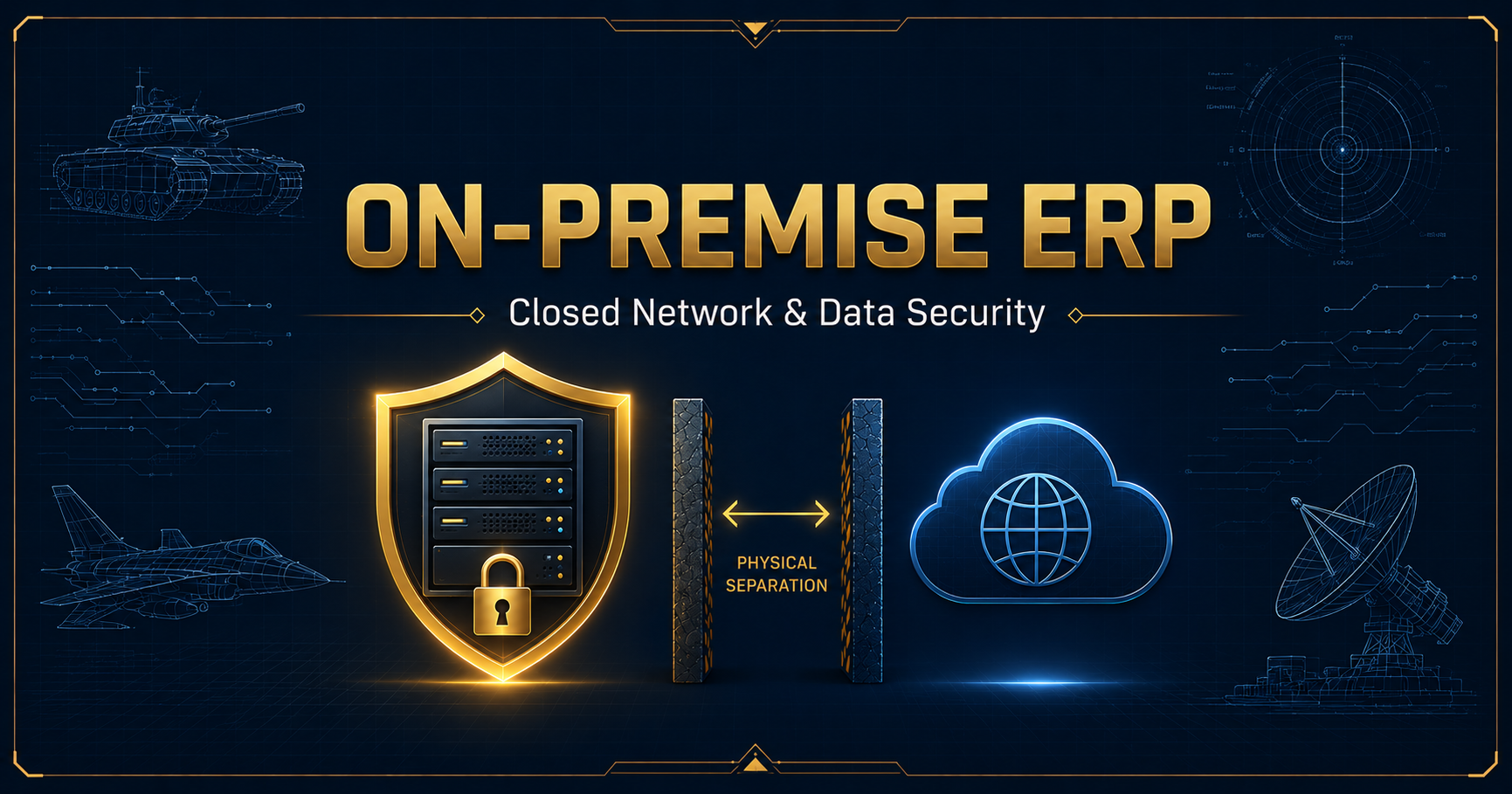
On-premise ERP is a model in which enterprise resource planning software runs on the organization’s own servers, in its own data center, rather than in the cloud. In sectors where data confidentiality is critical, such as the defense industry, this model ensures that data never leaves the organization. At the highest security level, the system runs in an air-gapped environment with no internet connection at all, physically eliminating the external attack surface. For manufacturers working with classified data in defense projects, on-premise and air-gapped capability is often a contractual requirement.
In the defense industry, a production record, technical drawing, or project detail is not merely a trade secret; it is often a matter of national security. For this reason, one of the most decisive criteria in ERP selection for defense manufacturers is where and how the system is hosted. This guide explains what on-premise ERP is, how an air-gapped architecture works, how it differs from cloud ERP, and how it ensures data security in the defense industry.
What Is On-Premise ERP?
On-premise ERP is a deployment model in which the ERP software and all of its data are hosted on the organization’s own physical infrastructure (its own servers and data center) rather than at a third-party cloud provider. In this model, the data is under the organization’s physical control; the organization alone decides who can access it, from where, and how.
In the defense industry, this is a critical advantage: classified technical data, project information, and production records stay within the organization’s boundaries. Keeping data on a cloud provider’s servers (often abroad) is frequently an unacceptable risk in defense projects.
What Is an Air-Gapped Environment?
An air gap is the complete physical isolation of a computer system from the internet and other untrusted networks. The term “air gap” refers to a physical disconnection between the system and the outside world; it is not possible to reach the system over a network from outside.
In an air-gapped ERP deployment:
- The system is not connected to the internet, so the remote cyberattack surface is physically eliminated.
- Data transfer is performed only through controlled and audited physical methods.
- The risk of unauthorized data exfiltration is minimized.
This architecture is preferred in the defense industry’s most confidentiality-sensitive projects. For general ERP security principles, you can also review our security in ERP applications guide.
What Is the Difference Between On-Premise ERP and Cloud (SaaS) ERP?
The two models differ fundamentally in terms of where data is kept and who controls it. The table below summarizes the key differences from a defense perspective:
| Criterion | On-Premise ERP | Cloud (SaaS) ERP |
|---|---|---|
| Data location | Organization's own server | Provider's server |
| Data control | Entirely with the organization | Shared with the provider |
| Internet dependency | Not required (can be air-gapped) | Mandatory |
| Air-gapped operation | Possible | Not possible |
| Defense confidentiality fit | High | Limited |
| Customization | Deep | Within provider limits |
Summary: Cloud ERPs offer speed and easy deployment, but their internet dependency and keeping data on the provider’s servers often conflict with the defense industry’s confidentiality requirements. Air-gapped operation is possible only in an on-premise architecture; a cloud-based ERP is by definition required to be connected to the internet and cannot run on a closed network.
Why Is On-Premise Mandatory in the Defense Industry?
For defense manufacturers, on-premise and air-gapped architecture is often not a preference but a requirement. The main reasons are:
- Classified data: In defense projects, technical data is subject to classification levels and requires physical control.
- Contract and audit terms: Prime contractors and government agencies may require suppliers to keep data domestically and in a controlled environment.
- Export control (ITAR/EAR): Protecting U.S.-origin technical data against unauthorized access requires a controlled infrastructure.
- Data sovereignty: Which country’s legal jurisdiction the data is kept in is a critical issue in defense projects.
- Reducing the attack surface: A system not connected to the internet provides the highest protection against remote cyber threats.
These requirements make an ERP’s ability to run on-premise and, when necessary, air-gapped indispensable for one serving the defense industry.
HarmonyERP’s On-Premise and Air-Gapped Architecture
This requirement, which cloud-based ERPs cannot meet, is HarmonyERP’s strongest differentiator in the defense industry. HarmonyERP ensures security with the real capabilities defined on its defense solution:
- On-premise deployment: The system runs on the organization’s own servers; data stays within organizational boundaries.
- Air-gapped operation: When required, it can run on an isolated network with no internet connection at all; the external attack surface is eliminated.
- Role-based access and authorization: Only authorized users can access controlled technical data; access is logged.
- Data sovereignty: The physical location and legal jurisdiction of the data are entirely under the organization’s control.
When selecting a defense industry ERP, whether the system supports this architecture is as decisive as its quality and production features; because in defense projects, security is not an “add-on” but a fundamental requirement.
Common Mistakes in On-Premise ERP Selection
- Thinking about security afterward. Asking “how do we move this to a closed network?” after the ERP is selected is too late; the architecture must be chosen from the start.
- Mistaking cloud ERP for air-gapped. A cloud-based system is by definition connected to the internet and cannot run on a closed network.
- Ignoring data sovereignty. Which country the data is kept in is a serious compliance matter in defense contracts.
- Leaving access control weak. Being on-premise alone is not enough; role-based authorization is essential internally as well.
- Skipping the backup and continuity plan. Since disaster recovery and backup responsibility rests with the organization in an on-premise architecture, it must be planned from the start.
Frequently Asked Questions
What is a defense industry ERP?
A defense industry ERP is enterprise resource planning software developed for aerospace and defense manufacturers that can run on-premise and, when necessary, air-gapped, and that requires compliance with strict quality standards such as AS9100 and ISO 9001, serial/lot-level traceability, and project-based manufacturing. It unifies production, quality, procurement, and data security processes on a single secure platform. HarmonyERP meets these needs with an on-premise architecture and role-based access control.
What is the difference between on-premise ERP and cloud ERP?
On-premise ERP hosts the software and data on the organization’s own servers; the data is under the organization’s physical control and can run air-gapped when needed. Cloud (SaaS) ERP keeps data on the provider’s servers and must run connected to the internet. In the defense industry, on-premise is preferred because of confidentiality requirements.
What does air-gapped ERP mean?
An air-gapped ERP is an ERP system running in an environment that is completely physically isolated from the internet and other untrusted networks. Since there is no network connection between the system and the outside world, the remote cyberattack surface is eliminated. It is preferred in the defense industry’s most confidentiality-sensitive projects and is possible only in an on-premise architecture.
Can cloud ERP be used in the defense industry?
Cloud ERP is often unsuitable for defense projects involving classified data because of its internet dependency and keeping data on the provider’s servers. It cannot run air-gapped and its data sovereignty is limited. On-premise architecture is required for such projects.
Does HarmonyERP work on a closed network?
Yes. HarmonyERP runs on the organization’s own servers with an on-premise architecture and can, when required, run in an air-gapped environment with no internet connection at all. This eliminates the external attack surface and keeps classified data within organizational boundaries. Role-based access control also secures authorization internally.
Conclusion
On-premise ERP keeps data under physical control by hosting the software and data on the organization’s own infrastructure; at the highest security level, the system runs in an internet-isolated air-gapped environment. In the defense industry, this architecture is often mandatory because of classified data, contract terms, export control, and data sovereignty. Although cloud ERPs offer speed, they cannot meet these requirements due to their internet dependency and data location.
HarmonyERP, with its architecture that can run on-premise and, when required, air-gapped, keeps defense manufacturers’ data within organizational boundaries and under full control. With 20+ years of enterprise software experience, we help aerospace and defense manufacturers build their ERP infrastructure in line with the highest security requirements. To see our secure defense-specific solution live, request a free demo.
Related guides: Defense Industry ERP Solution · HarmonyERP Overview · Security in ERP Applications
Transform Your Business with HarmonyERP
Manage manufacturing, accounting, inventory and sales from a single platform. Request a demo and see the difference.